

Indian Flavored Jaggery Powder

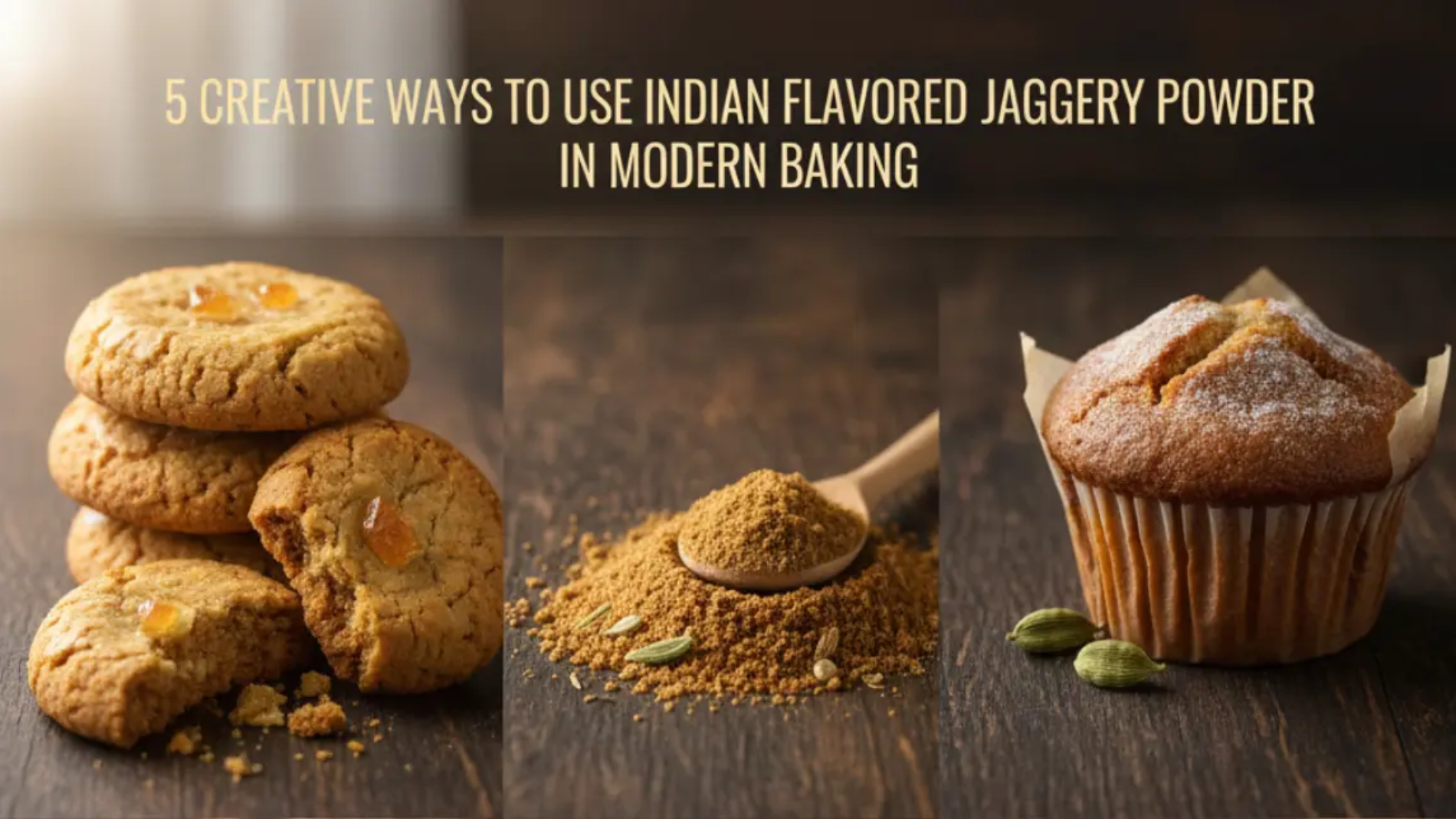
5 Creative Ways to Use Indian Flavored Jaggery Powder in Modern Baking

The world of modern baking is undergoing a delicious revolution. Home bakers and professional pastry chefs alike are moving away from the one-dimensional sweetness of refined white sugar and exploring natural alternatives that offer depth, aroma, and better nutrition. Leading this charge is a traditional ingredient with a gourmet twist: Indian Flavored Jaggery Powder.

While jaggery has been the soul of Indian sweets for centuries, its flavoured avatars—infused with natural spices like cardamom, ginger, and fennel—are now finding their way into cookies, cakes, and artisanal breads. This ingredient doesn’t just sweeten; it transforms. It brings the rich, molasses-like warmth of unrefined cane sugar combined with the aromatic zest of pure spices.

If you are looking to create baked goods that are cleaner, tastier, and uniquely aromatic, here are five creative ways to incorporate Indian Flavored Jaggery Powder into your modern baking repertoire.

1. Spiced Cookies and Shortbreads with a Twist

The easiest way to introduce this ingredient into your kitchen is through cookies. Traditional recipes for ginger snaps, molasses cookies, or even simple butter shortbreads can be elevated instantly.

Instead of using brown sugar and measuring out separate spices, simply swap the sugar for Ginger-infused Indian Flavored Jaggery Powder. The powder provides a caramel-like chewiness to the cookie texture that white sugar cannot replicate. The infused ginger offers a warmth that permeates the dough evenly, ensuring every bite has a consistent zesty kick.

For a fusion treat, try making Cardamom Shortbreads. The floral notes of the cardamom-infused jaggery pair beautifully with the rich butter, creating a sophisticated tea-time treat that requires fewer ingredients but delivers a complex flavor profile.

2. Moist and Aromatic Tea Cakes and Muffins

One of the best chemical properties of jaggery is that it is hygroscopic—meaning it attracts and holds moisture. This makes Indian Flavored Jaggery Powder a secret weapon for baking cakes and muffins that stay moist for days.

Imagine a Banana Walnut Muffin sweetened entirely with Cardamom Indian Flavored Jaggery Powder. The cardamom cuts through the density of the banana, adding a layer of aromatic elegance that usually requires a skilled hand with spice blends. Similarly, carrot cakes or pumpkin spiced lattes cupcakes can benefit from Masala-flavored jaggery, which typically contains a blend of ginger, pepper, and cardamom. It acts as an instant “spice mix” while acting as the primary sweetener, simplifying your baking process while enhancing the taste.

Spice Up Your Business with Authentic Indian Flavors

Import and Export Excellence from India!
3. Gourmet Glazes and Drizzles

Modern baking isn’t just about the sponge; it’s about the finish. While powdered white sugar is the standard for glazes, it often results in a cloyingly sweet topping. A glaze made from Indian Flavored Jaggery Powder offers a sophisticated alternative with a beautiful golden-amber hue.

To make a glaze, simply dissolve the flavored powder in a small amount of warm milk or cream. A Ginger Jaggery glaze is exceptional when drizzled over lemon pound cake or cinnamon rolls. The slight heat from the ginger balances the tartness of the lemon, while the earthy sweetness of the jaggery rounds out the flavors. This technique creates a “clean label” topping that looks rustic and artisan, appealing to health-conscious consumers who avoid white icing.

4. Reinventing Pie Fillings and Fruit Tarts

Fruit desserts require a sweetener that complements the fruit rather than masking it. Indian Flavored Jaggery Powder pairs exceptionally well with baked fruits, particularly apples, pears, and peaches.

When making an apple pie or a pear tart, toss the fruit slices in Cinnamon or Cardamom Flavored Jaggery Powder instead of white sugar. As the fruit bakes, the jaggery melts into a rich, spiced syrup that coats the fruit, creating a filling that is jammy, golden, and deeply flavorful. The inherent mineral content of the jaggery adds a subtle salinity that enhances the natural sweetness of the fruit, creating a dessert that tastes far more complex than a standard sugar-sweetened pie.

5. Artisan Breads and Sweet Doughs

Yeast loves sugar, but it thrives on the complex minerals found in jaggery. Using Indian Flavored Jaggery Powder in yeast-leavened breads is a fantastic way to boost fermentation while adding a unique flavor note to the crumb.

Consider a brioche or a sweet braided bread. By using a Fennel (Saunf) Flavored Jaggery Powder, you can create a bread with a subtle aniseed aroma that pairs wonderfully with savory spreads or mild cheeses. The jaggery gives the crust a darker, richer color due to caramelization and keeps the interior soft and tender. For sourdough bakers, adding a small amount of this powder to the dough can balance the acidity of the starter with an earthy, spiced sweetness.

Spice Up Your Business with Authentic Indian Flavors

Import and Export Excellence from India!

The Sweet Spot of Health and Flavor

Switching to Indian Flavored Jaggery Powder is more than a health decision; it is a culinary upgrade. It allows bakers to reduce their reliance on refined ingredients while simultaneously adding layers of flavor that would typically require a pantry full of spices.

Whether you are a home baker looking to make healthier treats for your family, or a professional looking for a unique selling proposition for your bakery, this versatile ingredient opens up a world of possibilities. It is the perfect bridge between the wholesome goodness of tradition and the creativity of modern baking.

Frequently Asked Questions (FAQs)

1. Can I substitute white sugar with Indian Flavored Jaggery Powder 1:1?

Yes, in most recipes like cakes and cookies, you can substitute it 1:1. However, because jaggery adds moisture, you might want to slightly reduce the liquid content (milk or water) in the recipe by a tablespoon.

2. Will flavored jaggery powder change the texture of my cake?

Jaggery is a natural humectant, meaning it retains moisture. This usually results in cakes and muffins that are softer, denser, and moister compared to those made with white sugar, which is often a desirable trait.

3. Does the flavor of the spices (cardamom/ginger) come through strongly after baking?

The flavors in Indian Flavored Jaggery Powder are infused and potent. While baking mellows them slightly, the aroma and taste remain distinct, often eliminating the need to add extra ground spices to the batter.

4. Is Indian Flavored Jaggery Powder suitable for making meringues or light sponges?

Jaggery is heavier than white sugar. While it is excellent for butter cakes, cookies, and breads, it may weigh down very light, airy mixtures like meringues or angel food cakes.

5. How should I store flavored jaggery powder to prevent clumping?

Jaggery attracts moisture from the air. Always store your powder in an airtight container in a cool, dry place. If you are buying in bulk, ensure the packaging has a moisture barrier liner.

6. Is this powder suitable for vegan baking?

Absolutely. Indian Flavored Jaggery Powder is a plant-based, cruelty-free sweetener, making it an excellent choice for vegan desserts where honey or bone-char processed sugar is avoided.

7. Can I use this powder for frostings?

Yes, but it will have a golden color. For buttercream, ensure the powder is very fine or dissolve it in a tiny amount of cream first to avoid a gritty texture. It makes for a delicious caramel-spiced frosting.

8. Does flavored jaggery powder have a lower glycemic index than sugar?

Jaggery is a complex carbohydrate and generally has a slightly lower glycemic index than refined sugar, meaning it releases energy more slowly. However, it is still a sweetener and should be used in moderation.

About us

We bridge the gap between local producers and global markets, ensuring seamless trade facilitation with exceptional quality and reliability. We provide quick delivery services with customized packaging with all approval of International Certificates (Spices board India, MSME, IEC, fssai, FIEO, APEDA, EU certification, FDA and Many More)

Contact us

Shop No. 3, Ganesh Prestige Sr. No. 2/15, Near Laxmi Jewellers, Dhanakawadi, Pune – 411043, Maharashtra INDIA.

Call On

+91 9545205050

+91 9822422584
Email

sales@aquaconnectexim.com

aquaconnectexim@gmail.com

Green Tea

Green Tea for Health: 5 Benefits You’ll Only Get from a High-Grade Powder

For centuries, green tea has been celebrated as one of the world’s healthiest beverages. It’s praised by wellness experts for its high antioxidant content and its role in supporting a healthy metabolism and a calm mind. Consumers drink it daily in the pursuit of these well-documented green tea benefits.

But here is a fact that may surprise you: if you are simply brewing and discarding the leaves, you are throwing away a vast majority of the plant’s most powerful nutrients.

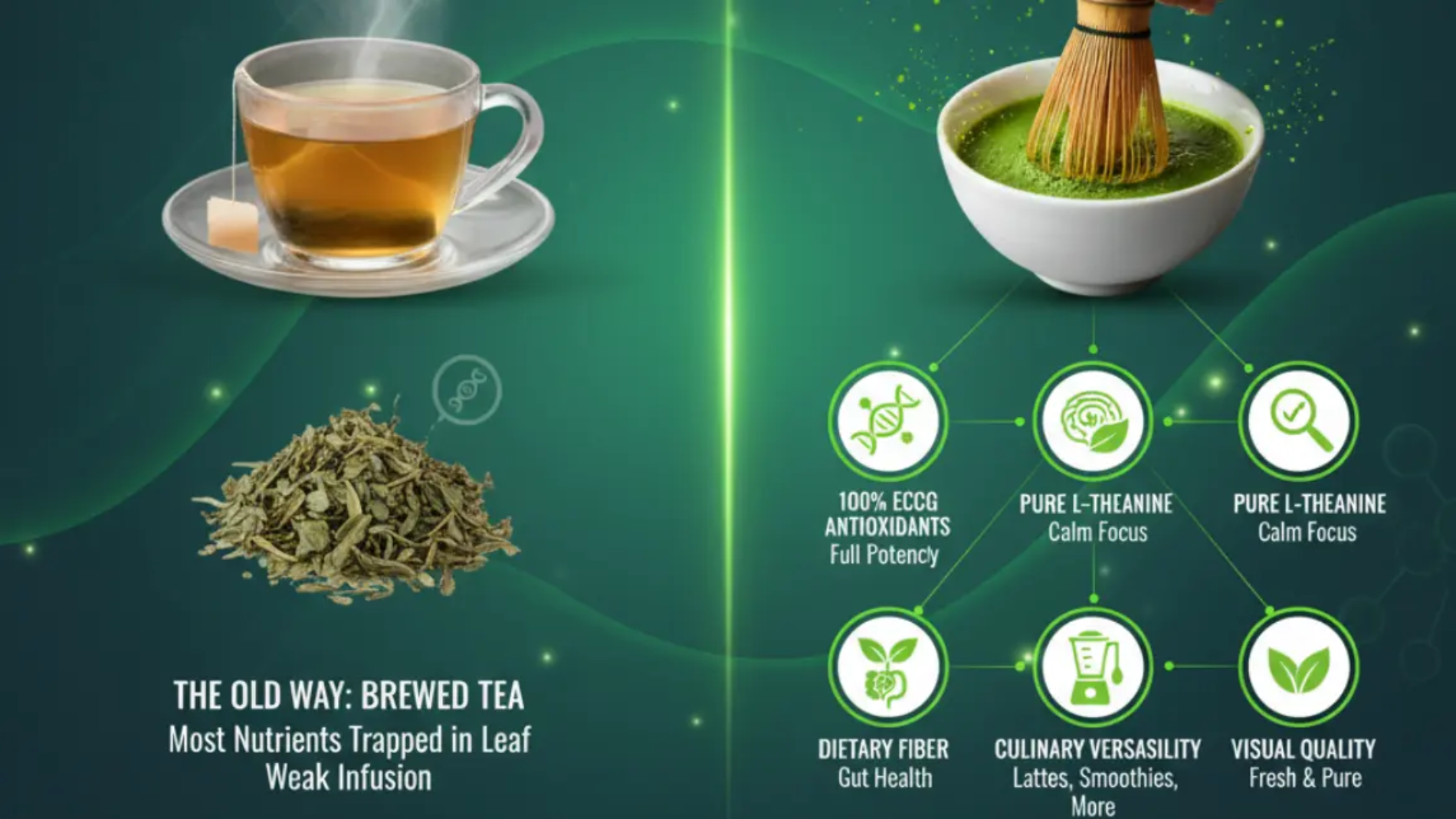
Brewing a cup of green tea is an inefficient infusion. Many of the most potent compounds, including the famous antioxidants and amino acids, are not fully water-soluble. They remain trapped in the leaf, which ends up in your compost bin.

To unlock 100% of the plant’s nutritional power, you must consume the entire leaf. This is where green tea powder comes in. By stone-grinding the whole, high-quality leaf into a fine powder, you get all the benefits in their most potent and bioavailable form.

Here are the five key health benefits you’ll only get from a high-grade powder.

1. You Consume 100% of the Antioxidants (EGCG)

Brewed green tea is famous for its catechins, a group of powerful antioxidants. The most famous of these is EGCG (Epigallocatechin Gallate), the compound linked to most of green tea’s profound health benefits.

The problem? EGCG is not highly soluble in water. When you brew a cup of tea, you might only get 20-30% of the available EGCG. The rest—the most potent part—remains locked in the leaf.

By consuming a high-grade powder, you are ingesting the entire leaf—which means you are getting 100% of the available EGCG and other catechins. One serving of powder can have the antioxidant equivalent of 10-15 cups of brewed tea, making it an exponentially more powerful way to fight free-radical damage and support cellular health.

Spice Up Your Business with Authentic Indian Flavors

Import and Export Excellence from India!

2. You Get the Full, Undiluted Dose of L-Theanine

One of the most unique green tea benefits is its “calm-alertness” effect. This is thanks to a rare amino acid called L-Theanine, which promotes relaxation and focus by increasing alpha waves in the brain. It’s the reason green tea feels energizing, not jittery.

Like EGCG, L-Theanine is also partially trapped in the leaf structure. While a brewed cup provides a small amount, a serving of green tea powder delivers the full, undiluted dose. This is why it has become a key ingredient for nutraceutical brands and in functional beverages designed to enhance focus, reduce stress, and provide a clean, sustained energy boost without the crash associated with coffee.

3. You Receive 100% of the Insoluble Dietary Fiber

This is a benefit that is completely absent in brewed tea. Tea leaves themselves are a plant, and like all plants, they contain dietary fiber. When you brew tea, you get zero fiber.

By consuming the whole-leaf powder, you are getting a significant boost of insoluble fiber. This fiber is essential for good digestion, as it helps to add bulk to your stool and promote regularity. It also acts as a prebiotic, feeding the healthy bacteria in your gut. For any consumer focused on gut health, the fiber-dense powder is the only logical choice.

4. You Gain True Culinary Versatility (for Lattes, Smoothies & More)

The health benefits of an ingredient are useless if you can’t easily incorporate it into your diet. This is where powder truly excels and why it is so valuable for food and beverage manufacturers.

You cannot make a creamy green tea latte, a nutrient-dense smoothie, or a batch of healthy baked goods with a tea bag. The powder format unlocks a world of culinary versatility, allowing you to add the full health benefits of green tea to other foods. This makes it an ideal clean label ingredient for:

  • Cafes: For high-margin lattes, frappes, and specialty drinks.

  • Food Manufacturers: For energy bars, bakery mixes, ice cream, and more.

  • Nutraceutical Brands: As the potent base for supplement blends.

5. You Can Instantly Verify the Quality

The quality of loose-leaf tea can be hidden. Low-grade, brownish “dust” is often packed into tea bags, and it’s hard to tell what you’re really getting.

With a high-grade powder, quality is visible.

  • Color: Premium Indian green tea powder, like our Signature Green Tea Powder, will have a vibrant, fresh, and bright green color. This indicates the leaves were young, properly shaded (if applicable), and processed with care, preserving the chlorophyll and antioxidants.

  • Texture: It should be stone-ground to an ultra-fine, silky-smooth mesh.

A dull, yellowish, or brownish powder is a red flag, indicating oxidation and a loss of potency. A high-grade powder guarantees you are getting the fresh, potent product you’re paying for.

Spice Up Your Business with Authentic Indian Flavors

Import and Export Excellence from India!

Stop Sipping a Shadow, Start Consuming the Source

Brewed green tea is a healthy beverage, but it’s only a pale shadow of the plant’s true potential. To get the full spectrum of antioxidants, the complete dose of L-Theanine, and the added benefit of dietary fiber, you must consume the entire leaf.

For consumers, this means more benefits in every serving. For food and beverage brands, it means a more potent, versatile, and marketable ingredient.

Frequently Asked Questions (FAQs)

1. Is green tea powder the same as matcha?

Not exactly, though they are similar. “Matcha” is a specific type of green tea powder, traditionally from Japan, where the leaves are shaded for weeks before harvest to increase chlorophyll and L-Theanine. Green tea powder is a broader term for any green tea that is ground, such as a high-quality Indian green tea powder. Both provide the benefit of consuming the whole leaf.

2. Does green tea powder have more caffeine than brewed tea?

Yes. Because you are consuming the entire leaf, you are ingesting all of its caffeine. A typical serving of powder may have 35-70mg of caffeine, similar to a strong cup of brewed tea or a small cup of coffee. However, the high dose of L-Theanine helps to mellow the effect and prevent jitters.

3. What is EGCG?

EGCG (Epigallocatechin Gallate) is a type of catechin, which is a powerful plant-based antioxidant. It is the most abundant and most active antioxidant in green tea and is the subject of most of the scientific research into its health benefits.

4. Will green tea powder taste bitter?

A high-grade powder should not be bitter. It should taste fresh, vegetal (or “green”), and have a slightly sweet, savory (umami) finish. Bitterness is usually a sign of low-quality leaves or using water that is too hot.

5. What is L-Theanine, and what does it do?

L-Theanine is an amino acid found almost exclusively in tea leaves. It is known to promote a state of “calm alertness” by increasing alpha brain waves, which are associated with relaxation and focus.

6. What’s the best way to use green tea powder?

The most popular ways are in a green tea latte (whisked with hot milk), blended into a fruit smoothie, or whisked with hot water as a traditional tea. It’s also a fantastic ingredient for baking.

7. Why is the bright green color so important?

The vibrant green color is from chlorophyll. It’s a visual indicator of freshness and quality. When green tea leaves are exposed to oxygen or sunlight for too long, they oxidize (like an apple turning brown), the chlorophyll degrades, and the color turns a dull, brownish-yellow. This oxidation also destroys the delicate antioxidants and ruins the flavor.

8. Is Indian green tea powder a good choice?

Yes, India’s premier tea-growing regions, like Darjeeling and Assam, produce exceptional green teas that are processed into high-quality powders. An Indian green tea powder from a reputable supplier offers a robust and flavourful profile, making it a perfect, high-quality ingredient for the global market.

About us

We bridge the gap between local producers and global markets, ensuring seamless trade facilitation with exceptional quality and reliability. We provide quick delivery services with customized packaging with all approval of International Certificates (Spices board India, MSME, IEC, fssai, FIEO, APEDA, EU certification, FDA and Many More)

Contact us

Shop No. 3, Ganesh Prestige Sr. No. 2/15, Near Laxmi Jewellers, Dhanakawadi, Pune – 411043, Maharashtra INDIA.

Call On

+91 9545205050

+91 9822422584
Email

sales@aquaconnectexim.com

aquaconnectexim@gmail.com

Indian CTC Black Tea Powder

Why Tea Bag Companies Exclusively Rely on CTC Black Tea Powder

The humble tea bag is a marvel of modern convenience. Billions are used daily across the globe, each one carrying a simple promise: a fast, satisfying, and consistent cup of tea. For the global tea bag companies and manufacturers who produce these items by the million, meeting this promise is a complex logistical and technical challenge.

To succeed, they cannot use just any tea. They rely almost exclusively on one specific type of product: Indian CTC Black Tea Powder.

While the world of artisanal tea is dominated by whole-leaf “orthodox” teas, the mass-market tea bag industry is built on the robust, efficient, and powerful foundation of CTC. As a leading finest black tea powder supplier based in India, we understand why this isn’t just a preference—it’s an engineering necessity. Here’s a deep dive into why CTC tea is the undisputed king of the tea bag.

1. The Need for Speed: Rapid and Powerful Infusion

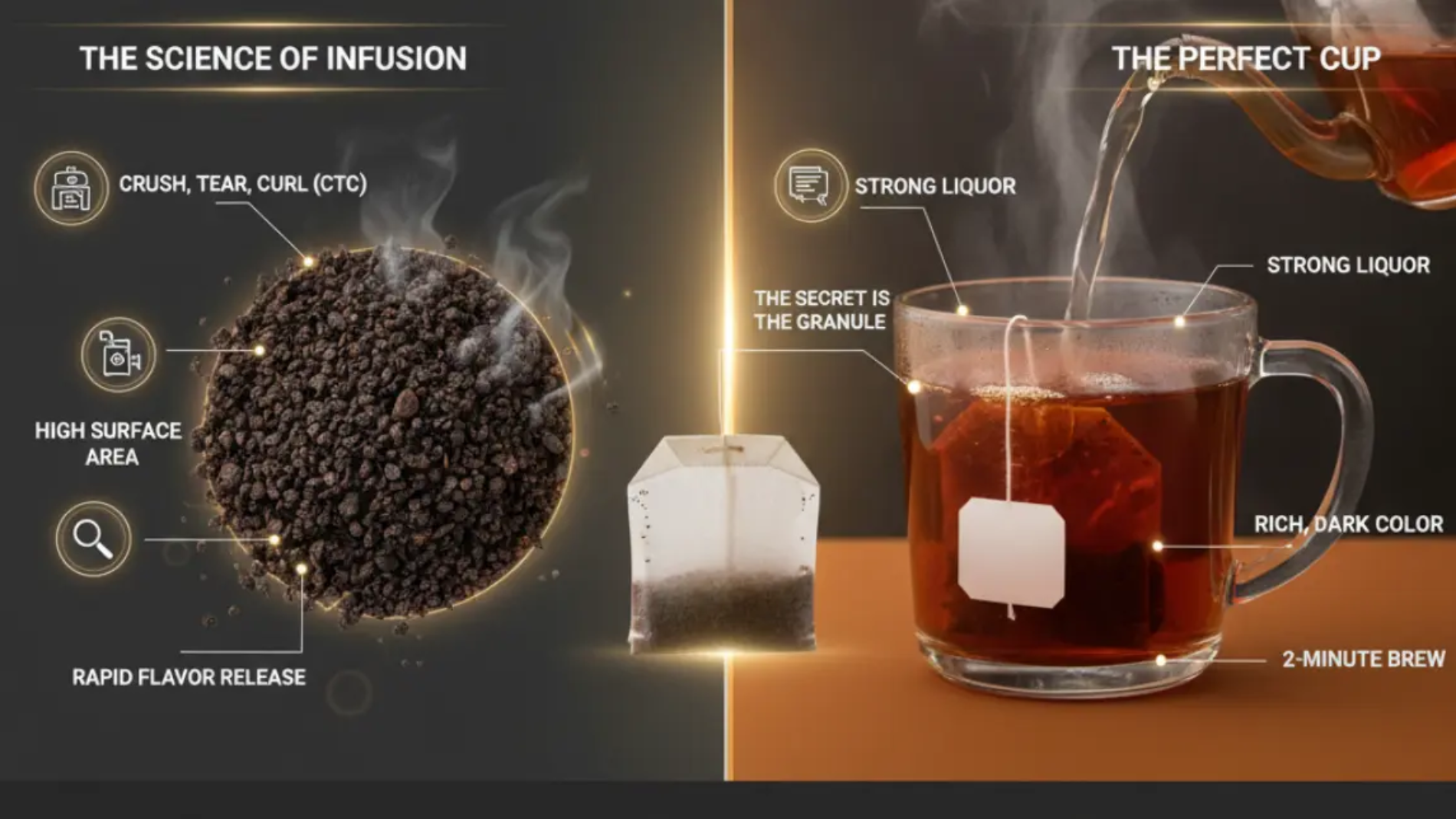
The modern tea drinker is not patient. A tea bag is expected to deliver a rich, dark cup of tea in 2-3 minutes, not the 5-7 minutes required for a loose-leaf pot. This is where CTC’s primary function shines.

CTC stands for Crush, Tear, Curl, a highly mechanized production method where fresh tea leaves are passed through a series of rollers that macerate and form them into small, hard, dense granules. These tiny pellets have an incredibly high surface-area-to-volume ratio.

When they hit hot water, they release their flavour, colour, and compounds almost instantly. This quick infusion process floods the water with a strong liquor and deep color, satisfying the consumer’s need for a fast and effective brew. A whole-leaf orthodox tea, by contrast, needs time to unfurl and slowly release its essence, making it completely unsuitable for a standard tea bag.

2. Consistency is King: The Power of Mechanization

A global tea brand must ensure that its English Breakfast tea tastes the same in London, New York, and Sydney. This level of consistency is impossible to achieve with artisanal, hand-processed teas. The Indian CTC Black Tea Powder process is a marvel of industrial precision.

The mechanized system of crushing, tearing, and curling ensures a 100% uniform product. The particle size, density, and oxidation level are meticulously controlled, batch after batch. This means that every single tea bag in a production run of millions will brew a cup of tea with the exact same strength, colour, and taste profile. For a brand’s reputation, this consistency is non-negotiable.

Spice Up Your Business with Authentic Indian Flavors

Import and Export Excellence from India!

3. A Perfect Fit: Why CTC Grades (Fannings & Dust) are Ideal

Tea bag manufacturing is a precise science. The bags are small and made of porous paper, and they need to be filled quickly by high-speed machinery. The output of the CTC process is not one single powder, but a range of tea grades sorted by particle size.

The two smallest grades are the lifeblood of the tea bag industry:

  • Fannings (OF – Orange Fannings): Small particles that are larger than Dust. They form the base of many blends, providing a great balance of brisk flavour and rich colour.

  • Dust (D/PD – Dust/Pekoe Dust): The finest particles. Dust infuses extremely quickly to produce the strongest, darkest liquor. It is a vital component for blends that need a powerful colour kick.

These grades are small enough to fit perfectly into a tea bag and infuse rapidly, but large enough that they don’t seep through the paper’s pores like a fine flour would. This allows blenders to create a precise “recipe” (e.g., 70% Fannings, 30% Dust) to craft their signature, replicable brew.

4. A Flavor Foundation Built for Milk and Sugar

The vast majority of black tea bags sold globally are not consumed black. They are taken with milk, sugar, or both. This requires a tea with a flavour profile that is strong enough to “cut through” the creaminess and sweetness without becoming weak or watery.

This is the superpower of Assam CTC tea. The Camellia sinensis assamica variety, grown in the Brahmaputra Valley, is famed for its bold, brisk, and malty flavour. This inherent strength is a feature, not a bug. A delicate, floral Darjeeling would be completely lost in a mug of milk. The robust character of Indian CTC Black Tea Powder is specifically prized because it provides the powerful, satisfying foundation that a breakfast tea requires.

5. The B2B Advantage: Supply Chain and Cost-Effectiveness

Finally, the realities of mass-market production demand an ingredient that is both cost-effective and available in massive quantities. India is the largest producer of CTC tea in the world.

  • Scale: Sourcing bulk black tea from an Indian tea supplier guarantees a stable, high-volume supply chain that can meet the colossal demands of multinational corporations.

  • Cost: The CTC process is highly efficient, fast, and high-yield. This efficiency makes it a more affordable and commercially viable raw material than the labor-intensive, time-consuming process of creating orthodox whole-leaf teas.

For tea bag companies, Indian CTC Black Tea Powder isn’t just one option among many. It is the perfect, engineered solution that meets their precise needs for speed, strength, consistency, and scale.

Spice Up Your Business with Authentic Indian Flavors

Import and Export Excellence from India!

Frequently Asked Questions (FAQs)

1. What do the CTC tea grades like BOP, OF, and PD mean?

These are size classifications. BOP (Broken Orange Pekoe) is a larger granule, often sold as a “strong” loose-leaf tea. OF (Orange Fannings) and PD (Pekoe Dust) are the smaller grades, which are ideal for tea bags due to their quick infusion.

2. Is CTC tea lower quality than whole-leaf (orthodox) tea?

It’s not lower quality; it’s different. It is engineered for a different purpose. Orthodox tea is prized for its subtle, complex, and delicate flavors (like wine). CTC tea is prized for its bold, strong, and consistent flavor, designed to stand up to milk and sugar.

3. Can you use orthodox (whole-leaf) tea in tea bags?

While some premium “pyramid” tea bags do use whole leaves, they are much more expensive and require a longer steeping time (4-5+ minutes). They are not suitable for the standard 2-minute brew that the mass market demands.

4. Why is Assam, India so famous for CTC tea?

The Assam region of India is the birthplace of the Camellia sinensis assamica tea plant, which has a naturally bold, robust, and malty flavour. This strong character is the perfect raw material for the CTC process, creating a final product that is renowned for its strength.

5. How is CTC black tea powder different from “instant tea”?

CTC Black Tea Powder (Fannings/Dust) consists of tiny, dried granules of the actual tea leaf that must be infused in hot water. “Instant tea” is a dehydrated crystal of already-brewed tea that dissolves completely in water (like instant coffee).

6. Does CTC tea have fewer health benefits?

No. CTC tea is still packed with the same antioxidants (flavonoids) and caffeine as orthodox tea. The primary difference is the flavor profile and infusion speed, not the core health benefits.

7. What is the best grade of CTC tea for a very strong “builder’s tea”?

A blend with a high percentage of Dust (PD) grade will produce the strongest, darkest, and quickest brew, which is often sought after for a classic “builder’s tea” or a strong breakfast blend.

8. How do I choose a good Indian tea supplier for my business?

Look for an experienced Indian tea supplier who understands the different tea grades and can provide a detailed Certificate of Analysis (COA) for each batch. They should be able to provide consistent blends that match your precise specifications for flavor, strength, and particle size.

About us

We bridge the gap between local producers and global markets, ensuring seamless trade facilitation with exceptional quality and reliability. We provide quick delivery services with customized packaging with all approval of International Certificates (Spices board India, MSME, IEC, fssai, FIEO, APEDA, EU certification, FDA and Many More)

Contact us

Shop No. 3, Ganesh Prestige Sr. No. 2/15, Near Laxmi Jewellers, Dhanakawadi, Pune – 411043, Maharashtra INDIA.

Call On

+91 9545205050

+91 9822422584
Email

sales@aquaconnectexim.com

aquaconnectexim@gmail.com

sourcing raw banana powder

Sourcing Raw Banana Powder: A Technical Guide to Mesh Size, Purity, and Color

The demand for functional, clean-label ingredients has skyrocketed, and leading the charge is raw banana powder. This powerhouse food ingredient, also known as green banana flour, is being actively sought by R&D teams and purchasing managers in the health food, gluten-free, and nutraceutical industries.

However, sourcing raw banana powder is a technical purchase. Unlike ripe banana powder, which is used for sweetness, raw banana powder is a functional ingredient prized for its starchy, neutral profile. For a product formulation to be successful, the powder must meet exact specifications. A slight variation in “mesh size,” “purity,” or “color” can drastically alter the texture, taste, and stability of a final product.

As an experienced Indian banana powder exporter, we understand that these details are not just details—they are everything. This guide will walk you through the three most critical technical specifications to look for when sourcing.

First, Why "Raw"? The Resistant Starch Factor

Before diving into the specs, it’s crucial to understand why you are sourcing “raw” powder. This ingredient is made from unripe, green bananas. Because they are not ripe, their sugar content is low, and their starch content is high.

Specifically, they are rich in Resistant Starch (RS2). This is the key functional benefit. Resistant starch acts as a prebiotic fiber, supporting gut health and managing blood sugar. This makes it a star ingredient for:

  • Gluten-free baking (as a gluten-free flour)

  • Smoothie mixes and protein blends

  • Nutraceutical and “gut health” products

  • Baby food formulations

Understanding this a-priori helps you to understand why the following specifications are so critical.

Spice Up Your Business with Authentic Indian Flavors

Import and Export Excellence from India!

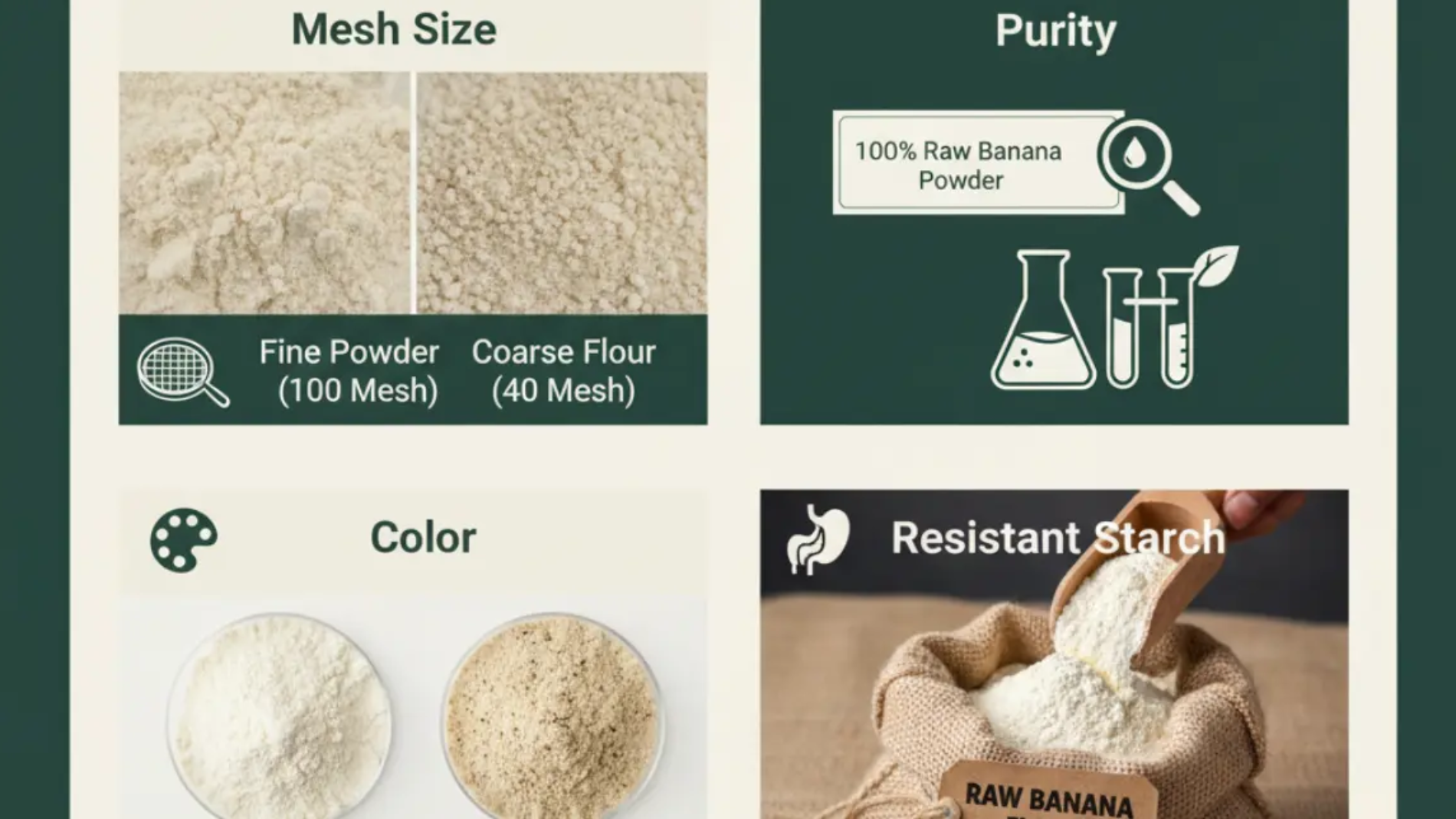
1. Mesh Size: The Key to Texture and Application

What it is: “Mesh size” (or particle size) refers to the fineness of the powder. It’s measured by its ability to pass through a specific-sized screen. A high number (e.g., 100 mesh) means a very fine powder, while a low number (e.g., 40 mesh) means a coarser, more granular powder.

Why it matters: The mesh size dictates the powder’s performance.

  • For Beverages & Smoothies (e.g., 80-100 Mesh): A fine powder is essential. It ensures better solubility and dispersibility in liquids, preventing a “gritty” or “sandy” mouthfeel. This is a non-negotiable for protein blends, meal replacements, and instant mixes.

  • For Baking (e.g., 40-60 Mesh): A slightly coarser granulation is often preferred. It mimics the texture of traditional wheat flours, providing a better structure and crumb in gluten-free breads, muffins, and cookies.

When sourcing raw banana powder, don’t just ask for “powder”; specify the mesh size that your application demands.

2. Purity: The "Clean Label" and Safety Guarantee

What it is: Purity, in this context, has two meanings: 1) freedom from adulterants, and 2) microbiological safety.

Why it matters: Today’s consumers are label-readers. Your product’s “clean label” appeal depends on the purity of its ingredients.

  • Adulteration: Because it’s a valuable flour, low-quality raw banana powder can be cut with cheaper starches or flours (like rice or tapioca). This dilutes the resistant starch content and compromises the nutritional profile. Your supplier must guarantee 100% pure banana powder.

  • Microbiological Safety: As a raw agricultural product, it must be tested and confirmed free from pathogens like Salmonella, E. coli, and Coliforms, and have a low overall plate count.

When sourcing, you must demand a Certificate of Analysis (COA) that verifies 100% purity and provides a clean microbiological report.

3. Color: The Visual Indicator of Quality and Process

What it is: A visual inspection of the powder. This is the fastest way to judge the quality of a sample.

Why it matters: The color of raw banana powder tells you exactly how it was processed. Many first-time buyers make the mistake of looking for a yellow, “banana-like” color. This is incorrect.

  • What You WANT (The Correct Color): A high-quality raw banana powder should be a pale, off-white, beige, or light greyish color. This indicates that unripe, starchy bananas were used and that they were dried correctly (e.g., spray-dried) at a controlled temperature.

  • What You DON’T WANT (Red Flags):

    • Yellow/Brown Color: This means ripe, sugary bananas were used, or the powder was “scorched” at a high temperature during drying. It will have a sweet, burnt taste and will lack the resistant starch you’re paying for.

    • Dark Specks: An excessive amount of black or brown specks can indicate the inclusion of skins or defects.

A good banana powder supplier will proudly provide a sample that is pale and consistent, a true indicator of its “raw” and “unburnt” quality.

Spice Up Your Business with Authentic Indian Flavors

Import and Export Excellence from India!

Sourcing with Confidence

Sourcing raw banana powder is a technical decision that directly impacts the quality of your final product. A “cheap” powder that fails on any of these three specifications—mesh, purity, or color—will ultimately fail in your formulation.

The key to success is to partner with a supplier who understands these banana powder specifications as well as you do. A reliable partner will be transparent, provide all necessary documentation (especially the COA), and be able to supply a consistent product, batch after batch.

Frequently Asked Questions (FAQs)

1. What is the main difference between raw and ripe banana powder?

Raw banana powder (or green banana flour) is starchy, not sweet, and used as a functional flour rich in resistant starch. Ripe banana powder is sweet, has a strong banana flavor, and is used as a natural sweetener and flavoring agent.

2. What is a Certificate of Analysis (COA)?

A COA is a lab report from the manufacturer or a third party that verifies the technical specifications of a specific batch of product. It is your guarantee that the powder meets the specs for purity, moisture, microbes, and more.

3. What is the typical shelf life of raw banana powder?

When processed to a low moisture content (typically < 8%) and stored in a cool, dry place in airtight packaging, export quality banana powder can have a shelf life of 12 to 24 months.

4. Can I get a certified organic version?

Yes. Many leading Indian banana powder suppliers offer certified organic options (e.g., USDA, EU Organic) for brands that require a fully organic and non-GMO product line.

5. Is raw banana powder truly 1:1 gluten-free flour replacement?

Not exactly. Due to its high starch content, it’s very absorbent. Most bakers find it works best when it replaces 25-30% of the total flour in a recipe, or when blended with other gluten-free flours.

6. Does the drying process (spray-dried vs. drum-dried) matter?

Yes. Spray-drying often produces a finer, more soluble powder that is ideal for beverage mixes. Drum-drying can be more cost-effective. The best method depends on your final application.

7. Why is India a good region for sourcing banana powder?

India is one of the world’s largest producers of bananas. This provides a massive, consistent, and cost-effective supply of raw materials for producing high-quality dehydrated products.

8. Will raw banana powder make my product taste like bananas?

No. This is a key benefit. Because it’s made from unripe bananas, it has a very neutral, slightly earthy, and “flour-like” taste, making it an excellent invisible ingredient in both sweet and savory applications.

About us

We bridge the gap between local producers and global markets, ensuring seamless trade facilitation with exceptional quality and reliability. We provide quick delivery services with customized packaging with all approval of International Certificates (Spices board India, MSME, IEC, fssai, FIEO, APEDA, EU certification, FDA and Many More)

Contact us

Shop No. 3, Ganesh Prestige Sr. No. 2/15, Near Laxmi Jewellers, Dhanakawadi, Pune – 411043, Maharashtra INDIA.

Call On

+91 9545205050

+91 9822422584
Email

sales@aquaconnectexim.com

aquaconnectexim@gmail.com

Indian Organic Green Tea Powder

Why the “Clean Beauty” Industry is Sourcing Indian Organic Green Tea Powder

The global beauty landscape has undergone a seismic shift. Consumers are no longer just buying products; they are buying transparency, ethics, and, above all, purity. This is the core of the “clean beauty” movement, and it has sent formulators and brands on a quest for ingredients that are not only effective but also natural, understandable, and verifiably safe.

In this search, one ancient ingredient has emerged as a modern superstar: Indian Organic Green Tea Powder.

While it has been a staple of wellness from the inside out for centuries, its potent benefits for the skin are now being leveraged by some of the most innovative cosmetic brands in the world. As an exporter of premium botanical ingredients, we’ve seen this demand skyrocket. Here’s a deep dive into why Indian Organic Green Tea Powder is becoming an essential clean beauty ingredient.

1. A Potent Antioxidant Powerhouse (EGCG)

The primary driver for using green tea for skin is its incredible antioxidant profile. Green tea is packed with polyphenols, particularly a catechin known as EGCG (Epigallocatechin Gallate).

EGCG is a powerful antioxidant that helps protect the skin by neutralizing free radicals. These damaging molecules—caused by pollution, UV rays, and other environmental stressors—are a primary cause of premature aging, fine lines, and hyperpigmentation.

By including a high-quality green tea powder in a skincare formulation, brands can create products that:

  • Protect the skin from environmental damage.

  • Support a more youthful, radiant complexion.

  • Offer a compelling, science-backed story for their antioxidant skincare line.

2. The "Organic" Guarantee: The Ultimate Mark of Purity

For the clean beauty industry, “organic” is not just a buzzword; it’s a non-negotiable standard. The skin is the body’s largest organ and can absorb a portion of what is applied to it. This makes the purity of a topical ingredient just as important as the purity of a food ingredient.

Sourcing Indian Organic Green Tea Powder provides a verifiable guarantee that the product is:

  • Pesticide-Free: Grown without the use of synthetic pesticides, herbicides, or fungicides that could irritate the skin or build up in the body.

  • Non-GMO: Free from genetically modified organisms.

  • Traceable: Sourced from certified farms that adhere to strict international standards (like NPOP, USDA Organic, or EU Organic).

This certification allows a brand to confidently market its product as truly “clean” and “safe,” which is a key purchasing driver for discerning consumers.

Spice Up Your Business with Authentic Indian Flavors

Import and Export Excellence from India!

3. Powerful Soothing & Anti-inflammatory Properties

Beyond its anti-aging benefits, green tea is a celebrated anti-inflammatory agent. This makes it incredibly versatile for a wide range of cosmetic products. The same catechins that provide antioxidant protection also work to soothe and calm the skin.

This makes Indian Organic Green Tea Powder a perfect ingredient for formulations targeting:

  • Acne and Blemishes: It can help reduce the redness and irritation associated with breakouts.

  • Sensitive Skin: Its gentle, calming nature makes it ideal for products that soothe and balance reactive skin.

  • Rosacea and Redness: It can help to visibly calm and reduce facial redness.

4. The L-Theanine & Caffeine Advantage

Green tea contains two other beneficial compounds: caffeine and L-Theanine.

  • Caffeine: When applied topically, caffeine is a well-known vasoconstrictor. This means it can help temporarily shrink blood vessels, making it a star ingredient for “de-puffing” eye creams and reducing the appearance of dark circles.

  • L-Theanine: This unique amino acid is known for its “calm-alertness” effect when consumed, but on the skin, it contributes to the tea’s overall soothing and hydrating properties.

5. Versatility in Skincare Formulation

Indian Organic Green Tea Powder is not a one-trick pony. Its fine particle size and stability allow it to be incorporated into a wide array of cosmetic products, making it a highly versatile raw material for a brand’s entire portfolio.

Its most popular uses include:

  • Face Masks: As the primary active ingredient in detoxifying and antioxidant-rich clay masks.

  • Cleansers & Scrubs: As a gentle exfoliant and soothing agent.

  • Serums & Essences: Where its EGCG-rich extract can be delivered in a concentrated form.

  • Lotions & Creams: To provide all-day antioxidant protection and calming benefits.

Spice Up Your Business with Authentic Indian Flavors

Import and Export Excellence from India!

Sourcing the Right "Cosmetic-Grade" Powder

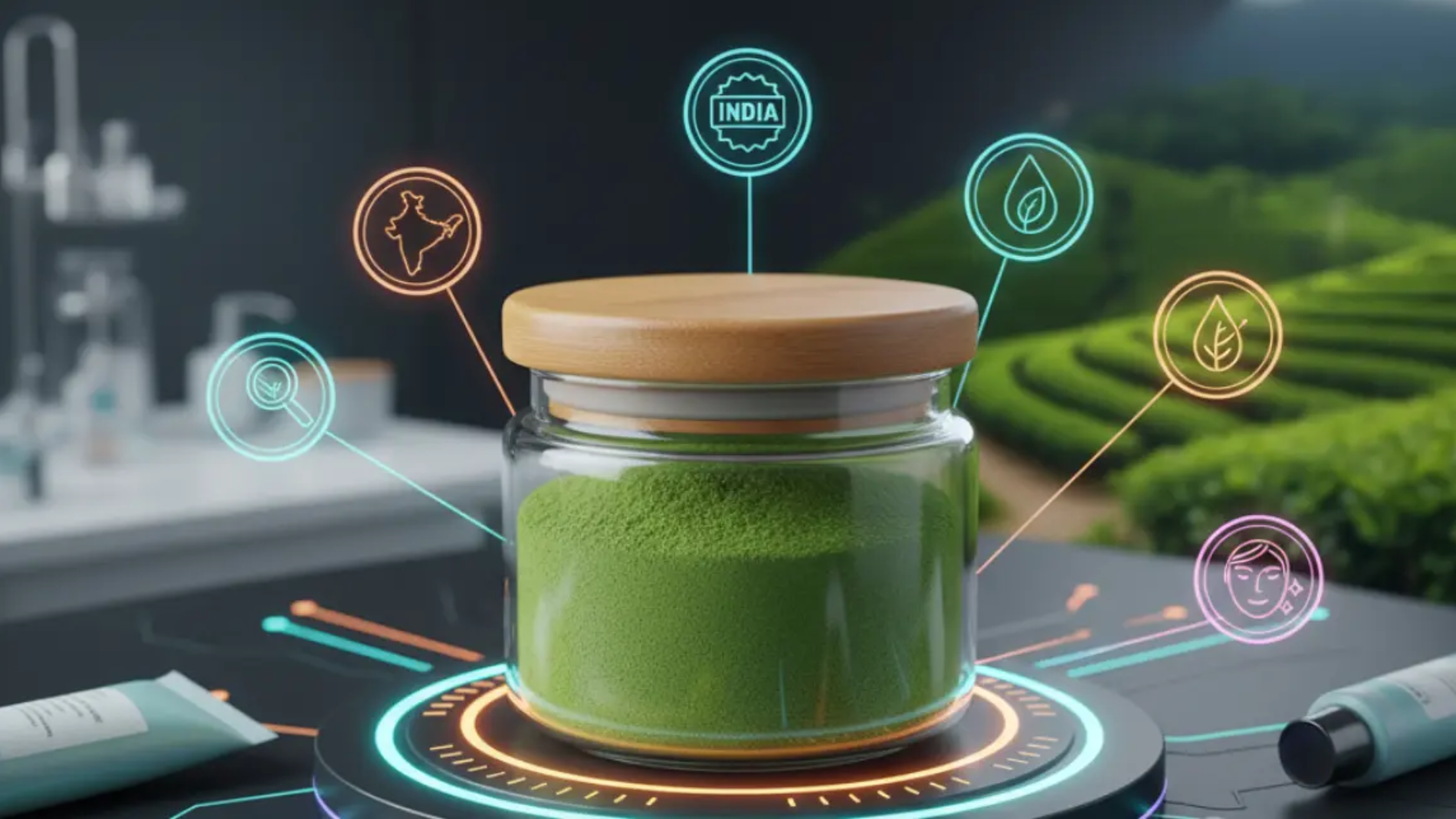
For a beauty brand, the quality of the raw material is paramount. A cosmetic-grade green tea powder must meet standards that are often even stricter than food-grade. When sourcing, it is essential to partner with an Indian tea supplier who understands these requirements and can provide:

  • A vibrant, fresh green color: A brown or yellowish powder is a sign of oxidation and depleted antioxidants.

  • A fine particle size (mesh): This ensures a smooth, non-gritty texture in the final formulation.

  • A comprehensive Certificate of Analysis (COA): This must verify the powder is free from heavy metals, microbes, and pesticides.

In conclusion, Indian Organic Green Tea Powder is the perfect ingredient for the clean beauty movement. It is natural, effective, sustainable, and backed by both ancient wisdom and modern science.

Frequently Asked Questions (FAQs)

1. What are the main benefits of organic green tea powder for skin?

The main benefits are its powerful antioxidant properties (from EGCG), which protect against aging, and its anti-inflammatory properties, which help to soothe redness, irritation, and acne.

2. Is the caffeine in green tea powder good for all skin types?

Topical caffeine is generally well-tolerated and is excellent for reducing puffiness, especially around the eyes. However, as with any active ingredient, those with extremely sensitive skin should patch-test.

3. What’s the difference between cosmetic-grade and food-grade green tea powder?

The primary differences are purity and particle size. Cosmetic-grade powder must pass stricter microbiological and heavy metal tests and is milled to an ultra-fine particle size for a smooth, luxurious texture in creams and serums.

4. Will the green powder stain my skin?

No. At the concentrations used in skincare formulation, the natural green color will not stain the skin. It imparts a pleasant, natural color to products like face masks that washes away easily.

5. Can I use this in an oil-based product like a facial oil?

Green tea powder itself is not oil-soluble, but its extracts are. The powder is best used in water-based formulas (serums, creams) or in suspension (like a clay mask).

6. What does EGCG stand for?

EGCG stands for Epigallocatechin Gallate. It is the most abundant and most powerful antioxidant catechin found in green tea, and it is the primary compound responsible for its skin-protective benefits.

7. Why is “Indian” organic green tea specified?

India, with its world-renowned tea-growing regions like Assam and Darjeeling, has a long history of producing high-quality, potent teas. Sourcing from a reputable Indian tea supplier ensures access to this expertise and quality.

8. How can I be sure the powder is truly organic?

Always ask your supplier for their valid organic certifications, such as NPOP (for India), USDA Organic, or EU Organic. A trustworthy supplier will provide these documents and a batch-specific COA.

About us

We bridge the gap between local producers and global markets, ensuring seamless trade facilitation with exceptional quality and reliability. We provide quick delivery services with customized packaging with all approval of International Certificates (Spices board India, MSME, IEC, fssai, FIEO, APEDA, EU certification, FDA and Many More)

Contact us

Shop No. 3, Ganesh Prestige Sr. No. 2/15, Near Laxmi Jewellers, Dhanakawadi, Pune – 411043, Maharashtra INDIA.

Call On

+91 9545205050

+91 9822422584
Email

sales@aquaconnectexim.com

aquaconnectexim@gmail.com

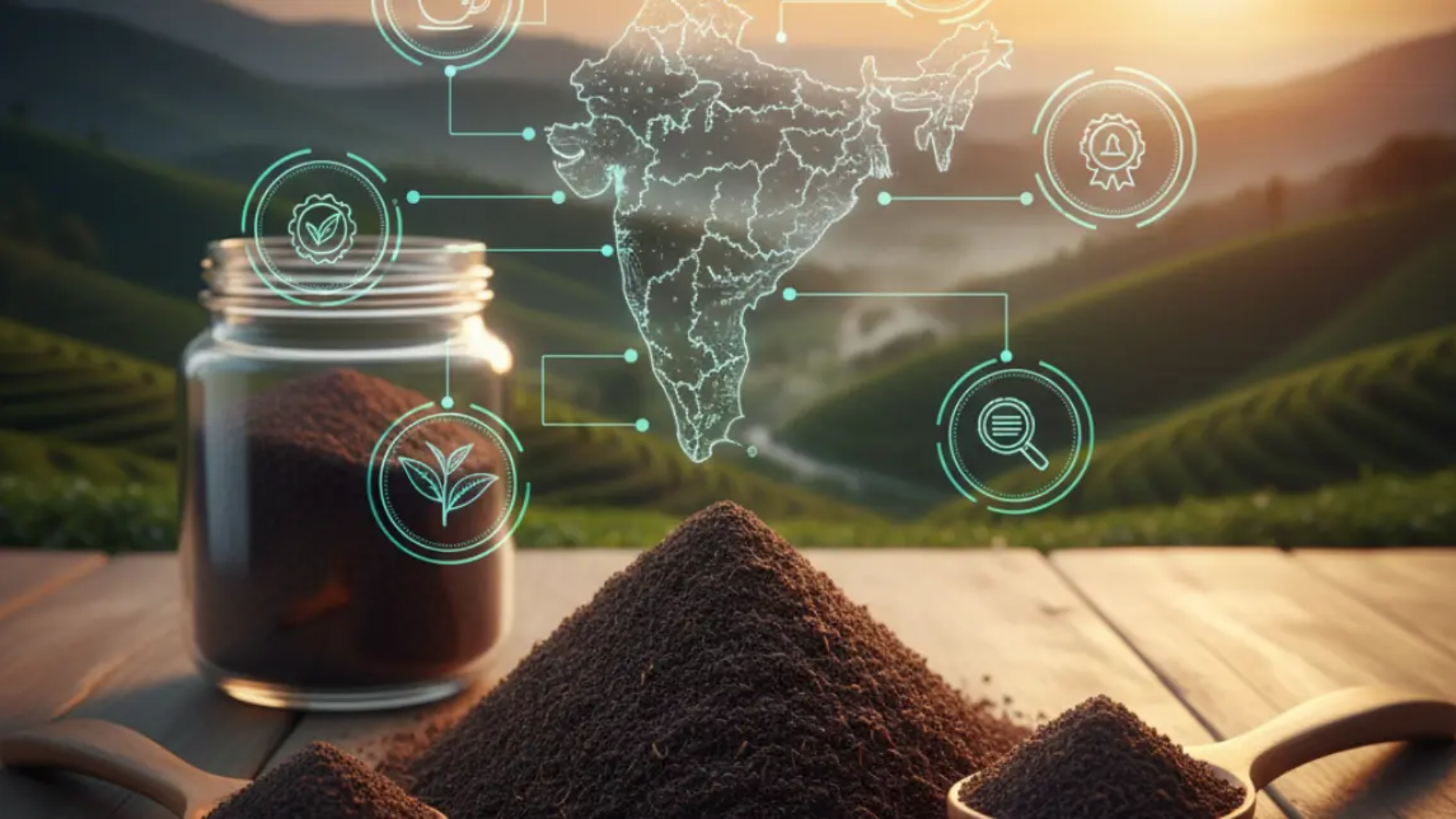
Indian Nilgiri Black Tea Powder

What is Nilgiri Black Tea Powder? A Guide to South India’s Fragrant Treasure

When international tea buyers think of India, their minds often jump to two legendary names: the bold, malty power of Assam and the delicate, muscatel “Champagne” of Darjeeling. But nestled in the pristine southern hills lies the third, and perhaps most versatile, star of the Indian tea world: Nilgiri.

Indian Nilgiri Black Tea Powder is a fragrant treasure, prized by discerning blenders and beverage manufacturers for a unique set of characteristics that its northern counterparts cannot match. As an experienced Indian tea exporter with deep roots in the nation’s tea trade, we’ll explore what makes this specific variety a strategic and high-value ingredient for the global market.

The Origin: A Gift from the "Blue Mountains

The story of Nilgiri tea is inseparable from its origin. The name “Nilgiri” literally translates to “Blue Mountains”—a stunning, high-altitude mountain range in the state of Tamil Nadu, South India. This unique terroir is the secret to its special nature.

Unlike the defined seasonal “flushes” of Assam and Darjeeling, the cool, misty, and stable high-altitude climate of the Nilgiris allows for tea to be harvested year-round. This provides a significant advantage for importers and manufacturers: a consistent, reliable, and stable supply chain. The tea bushes, grown at elevations up to 2,500 meters, produce leaves that are bright, clean, and bursting with fragrant oils.

The Signature Profile: Aroma Over Astringency

The primary differentiator for Indian Nilgiri Black Tea Powder is its exceptional flavour profile. While Assam is defined by strength and Darjeeling by delicacy, Nilgiri is defined by its fragrance.

A high-quality Nilgiri brew is incredibly aromatic, with bright floral notes and a crisp, fruity finish. But its most important characteristic for a B2B buyer is its naturally low tannin content.

Tannins are the compounds that cause the bitter, astringent, and “puckering” sensation in many black teas. Because Nilgiri is a low tannin tea, it has a wonderfully smooth, mellow, and “forgiving” taste. It lacks the harsh bitterness that can be a challenge in other teas, making it exceptionally easy to work with in blends and formulations.

Spice Up Your Business with Authentic Indian Flavors

Import and Export Excellence from India!

The "Iced Tea" King: A Critical B2B Application

For the global beverage industry, Nilgiri’s low tannin profile is not just a bonus; it’s a game-changing technical advantage.

Have you ever made a batch of iced tea that turned cloudy, murky, or “creamed down” as it cooled? That cloudiness is caused by the tannins and other compounds binding together at cold temperatures.

Indian Nilgiri Black Tea Powder does not cloud when chilled.

Its low tannin content allows it to remain perfectly clear, bright, and visually appealing, even when ice-cold. This makes it the undisputed #1 choice for beverage manufacturing, especially for:

  • Ready-to-Drink (RTD) Iced Teas: It provides a crystal-clear base that is visually appealing on a retail shelf.

  • Iced Tea Concentrates: Used by food service and cafes, it guarantees a clear, consistent product.

  • Cold Water Soluble (CWS) Powders: It is the ideal raw material for instant tea powders that dissolve easily in cold water.

The Blender's Dream Ingredient

For tea blenders and product developers, Nilgiri’s profile is a versatile canvas. Its subtle, non-overpowering flavour and high aroma make it the perfect base for value-added tea products.

Because it doesn’t have the malty dominance of Assam, it beautifully complements other, more delicate flavours. It is the ideal foundation for creating:

  • Fruit-Flavored Teas: (e.g., Peach, Lemon, Raspberry)

  • Floral Blends: (e.g., Rose, Jasmine)

  • Spiced Teas: Where a lighter, more aromatic base is desired.

Its fragrant lift enhances other ingredients without competing with them, making it a true blender’s dream.

Sourcing Premium Nilgiri Black Tea Powder

When sourcing Indian Nilgiri Black Tea Powder for export, quality is key. As a finest black tea powder supplier, we know that quality is defined by more than just origin.

For a B2B buyer, the powder format offers immense advantages in solubility, consistency, and ease of use over whole leaves. When evaluating a supplier, you must look for:

  • A Certificate of Analysis (COA): This is your guarantee of quality, verifying specifications like moisture content, particle size (mesh), and microbiological safety.

  • Vibrant Colour & Aroma: The dry powder should be bright and intensely fragrant. A dull, dusty-smelling powder is a sign of old or low-grade material.

  • Traceability: A good supplier should be able to provide traceability back to the Nilgiri region, ensuring you are sourcing an authentic product.

While it may be the third of India’s great teas, Nilgiri is second to none in its unique applications. It is a fragrant, versatile, and technically superior ingredient for the modern beverage market.

Spice Up Your Business with Authentic Indian Flavors

Import and Export Excellence from India!

Frequently Asked Questions (FAQs)

1. How does Nilgiri’s flavour differ from Assam and Darjeeling?

Assam is strong, bold, and malty (great with milk). Darjeeling is delicate, floral, and has a “muscatel” (grape-like) note (best on its own). Nilgiri is highly aromatic, fragrant, and fruity, with a smooth, non-bitter finish.

2. What are tannins in tea?

Tannins are a natural group of polyphenols in tea. They are responsible for the astringent, mouth-drying, and sometimes bitter qualities of a brew. They are also the compounds that cause tea to cloud when chilled.

3. Is Nilgiri tea always black tea?

While most famous for its black tea, the Nilgiri region also produces excellent oolong and green teas, which share the same characteristic aromatic and floral notes.

4. Can I use Nilgiri black tea powder for a milk tea or chai?

You can, but it’s not its strength. Its delicate, fragrant notes tend to get lost in milk and heavy spices. A robust Assam CTC tea is the industry standard for a strong milk tea or masala chai.

5. Is Nilgiri tea harvested year-round?

Yes. Unlike the seasonal “flushes” in Darjeeling and Assam, the high-altitude, equatorial climate of the Nilgiris allows for tea to be plucked all 12 months of the year, ensuring a stable and consistent supply.

6. What does “RTD” stand for?

RTD stands for “Ready-to-Drink,” which refers to packaged beverages, like bottled or canned iced teas, that are sold for immediate consumption.

7. Is Nilgiri tea powder the same as instant tea?

High-quality Nilgiri black tea powder is often processed as an “instant tea,” meaning it is fully soluble in hot or cold water. This is what makes it a key ingredient for beverage manufacturing.

8. How do I find a reliable Indian tea supplier for Nilgiri tea?

Look for an experienced Indian tea exporter who understands the nuances of the different tea regions. They should be able to provide samples, a detailed Certificate of Analysis (COA), and clear information on the tea’s grade and intended application.

About us

We bridge the gap between local producers and global markets, ensuring seamless trade facilitation with exceptional quality and reliability. We provide quick delivery services with customized packaging with all approval of International Certificates (Spices board India, MSME, IEC, fssai, FIEO, APEDA, EU certification, FDA and Many More)

Contact us

Shop No. 3, Ganesh Prestige Sr. No. 2/15, Near Laxmi Jewellers, Dhanakawadi, Pune – 411043, Maharashtra INDIA.

Call On

+91 9545205050

+91 9822422584
Email

sales@aquaconnectexim.com

aquaconnectexim@gmail.com

dehydrated banana powder

From Fresh Fruit to Fine Powder: The Process of Making Dehydrated Banana Powder

How does a soft, perishable banana, with its high moisture content and short shelf life, transform into a stable, versatile, and flavourful powder? The journey from fruit to a fine, free-flowing powder is a marvel of modern food processing. For food manufacturers and importers, understanding this process is key to sourcing a high-quality, consistent, and effective ingredient.

Dehydrated Banana Powder is more than just a convenience; it’s a precisely engineered product. As an experienced Indian banana powder exporter, we believe in transparency. This guide peels back the curtain on the meticulous, multi-stage process required to create this essential food ingredient.

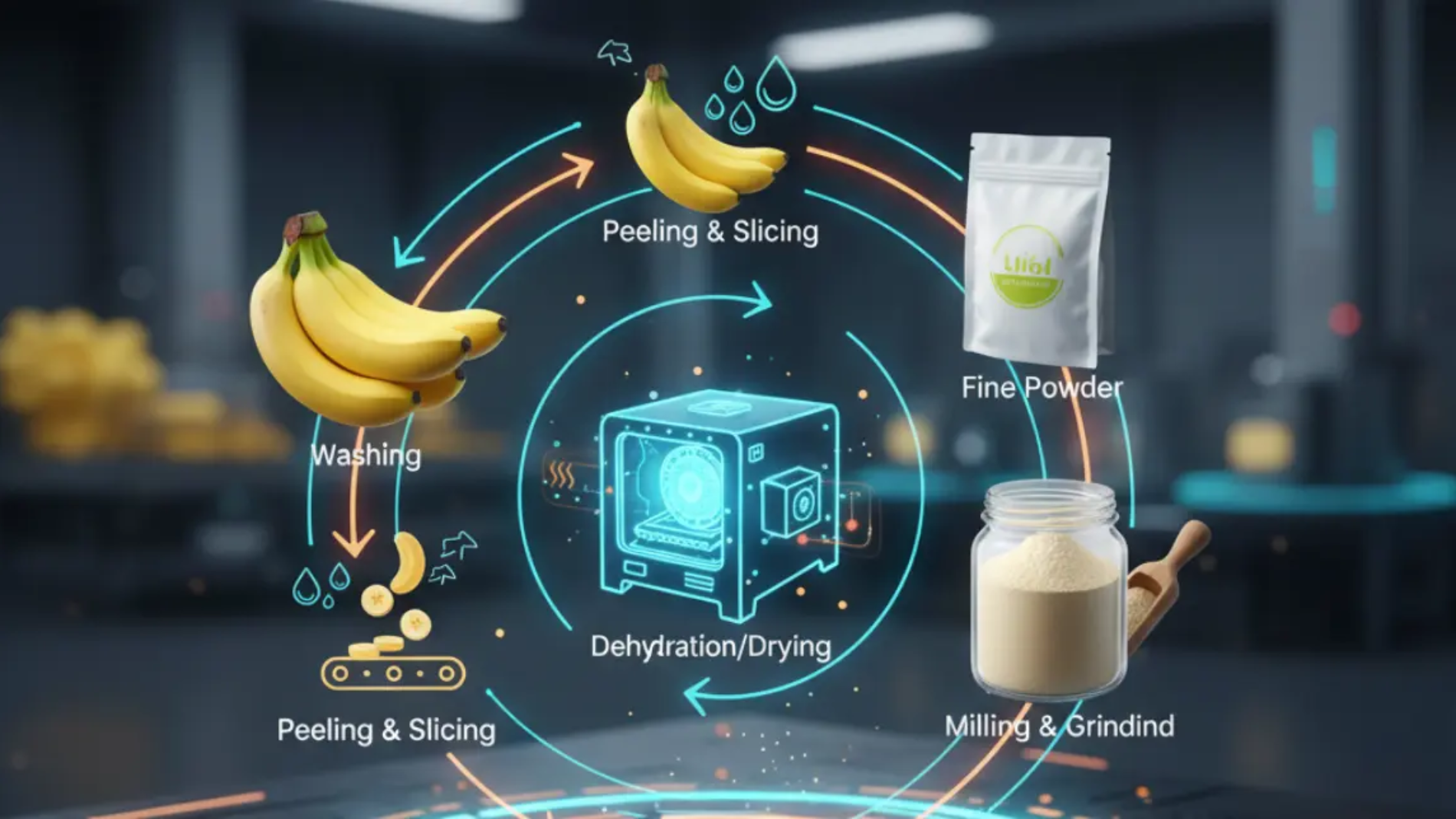
Step 1: The Foundation – Meticulous Raw Material Selection

The quality of the final powder is determined before the process even begins. It starts with the selection of the right raw material. This is a critical step where the end-use of the powder is the deciding factor.

  • For Sweetness & Flavor (Ripe Banana Powder): To create a powder that functions as a natural sweetener and flavouring agent, fully mature, yellow bananas with the right Brix (sugar) level are chosen. This ensures a rich, authentic banana taste, perfect for cereals, baby food, and bakery mixes.

  • For Functional Fiber (Raw Banana Flour): To create a starchy, gluten-free flour high in resistant starch, unripe green bananas are used. This results in the product commonly known as banana flour.

Only fresh, high-quality fruits, free from blemishes and defects, are selected to move to the next stage.

Step 2: Preparation – Peeling, Slicing, and Pre-Treatment

Once the right bananas are selected, the preparation phase begins. This stage is crucial for ensuring the final product’s quality and colour.

The bananas are washed to remove any surface impurities and then carefully peeled. They are then sliced into uniform thin pieces or turned into a liquid purée. Uniformity is key here, as it ensures that every piece dries at the same rate. In some cases, a natural anti-browning agent, such as a citric or ascorbic acid solution, may be used to prevent oxidation and maintain the powder’s light, creamy colour.

Spice Up Your Business with Authentic Indian Flavors

Import and Export Excellence from India!

Step 3: The Heart of the Process – Advanced Dehydration Methods

This is the most critical stage, where water is removed to create a shelf-stable product. The two primary industrial methods for producing high-quality dehydrated banana powder are Spray Drying and Drum Drying.

  • Spray Drying (The Gold Standard for Powders): This is the most advanced and widely used method for premium powders. The banana purée is atomized (sprayed as a fine mist) into a chamber of hot air. The water evaporates almost instantly, and the fine, dry powder particles fall to the bottom for collection. Spray-dried banana powder is prized for its very fine particle size, high solubility, and excellent preservation of flavour and nutrients.

  • Drum Drying: In this method, the banana purée is spread as a thin film onto the surface of a large, heated rotating drum. The heat dries the purée, which is then scraped off as a thin sheet or flakes. These flakes are then milled into a powder. While effective, this method can sometimes impart a slightly more “cooked” flavour due to direct contact with the hot surface.

Step 4: Milling and Sieving – Achieving the Perfect Texture

After dehydration, the product is not yet a perfect powder. It is then milled to break down any larger particles and create a uniform, fine consistency.

Following milling, the powder is passed through a series of sieves or screens to classify it according to particle size (mesh). This is a critical quality control step that ensures the final product meets the exact banana powder specifications required by the manufacturer, whether it’s for a smooth beverage mix or a textured bakery application.

Step 5: Final Quality Control and Export-Grade Packaging

The final stage is a rigorous quality check. Samples from the finished batch are sent to a lab to verify key parameters. This is where a trusted banana powder supplier demonstrates their commitment to quality. The results are presented in a Certificate of Analysis (COA), which confirms:

  • Moisture Content: Must be very low (typically below 8%) for a long shelf life.

  • Microbiological Safety: Ensuring the product is free from harmful bacteria.

  • Purity: Confirming it is 100% banana powder.

Finally, the powder is packed into multi-wall paper or HDPE bags with a heat-sealed inner poly-liner. This packaging is designed to protect the hygroscopic (moisture-absorbing) powder during its long export journey.

From a carefully selected fresh fruit to a precisely engineered powder, the process is a testament to the power of food science in delivering nature’s goodness in a stable, reliable, and highly functional format.

Spice Up Your Business with Authentic Indian Flavors

Import and Export Excellence from India!

Frequently Asked Questions (FAQs)

1. What is the difference between spray-dried and drum-dried banana powder?

Spray-dried banana powder is generally a finer, more soluble powder, making it ideal for beverages and instant mixes. Drum-dried can result in a slightly coarser flake or powder and is also widely used, but spray-drying is often considered the premium method for fine powders.

2. Does the dehydration process destroy the nutrients in the banana?

Modern, controlled drying methods like spray-drying are very fast and are designed to minimize heat exposure, which helps to preserve the majority of the banana’s natural vitamins and minerals, especially potassium.

3. What is the typical shelf life of dehydrated banana powder?

When processed to a low moisture content and stored in its original, unopened packaging in a cool, dry place, it typically has a shelf life of 12 to 18 months.

4. What does “mesh size” mean for banana powder?

Mesh size refers to the particle size of the powder, indicating how fine it is. A higher mesh number (e.g., 100 mesh) means a finer powder, which is better for smooth-textured products.

5. Is dehydrated banana powder the same as banana flour?

The terms are often used interchangeably, but there’s a key difference. Banana flour is almost always made from unripe, green bananas (it’s starchy, not sweet). Dehydrated banana powder is a broader term that can refer to powder made from either ripe or raw bananas.

6. Can dehydrated banana powder be certified organic?

Yes, absolutely. Sourcing certified organic powder is a popular choice, especially for the baby food and health food industries, ensuring the bananas were grown without synthetic pesticides.

7. Why is sourcing from India a good choice?

India is one of the world’s largest producers of bananas. This provides a massive, reliable supply of raw materials. Experienced Indian exporters have sophisticated manufacturing processes and a deep understanding of the quality standards required for the global market.

8. How can I be sure of the quality I’m receiving?

Always request a batch-specific Certificate of Analysis (COA) from your supplier. This is your scientific guarantee that the product meets the required specifications for moisture, purity, and safety.

About us

We bridge the gap between local producers and global markets, ensuring seamless trade facilitation with exceptional quality and reliability. We provide quick delivery services with customized packaging with all approval of International Certificates (Spices board India, MSME, IEC, fssai, FIEO, APEDA, EU certification, FDA and Many More)

Contact us

Shop No. 3, Ganesh Prestige Sr. No. 2/15, Near Laxmi Jewellers, Dhanakawadi, Pune – 411043, Maharashtra INDIA.

Call On

+91 9545205050

+91 9822422584
Email

sales@aquaconnectexim.com

aquaconnectexim@gmail.com

indian Jaggery Cubes

The Health Benefits of Indian Jaggery Cubes (And the Easiest Way to Use It Daily)

In the global search for healthier, more natural alternatives to refined sugar, many are rediscovering an ancient treasure from the heart of India. For centuries, households have relied on the wholesome sweetness of Indian Jaggery Cubes. These dense, golden-brown blocks of unrefined sugar are more than just a sweetener; they are a traditional food packed with nutrients and celebrated for their wellness properties.

But what exactly are these benefits, and what is the best way to incorporate this superfood into a modern, busy lifestyle? As an exporter based in Pune, in the heart of Maharashtra’s rich jaggery-producing region, we’ll dive into the health advantages of traditional gur cubes and reveal the most convenient way to enjoy them every day.

What Are Indian Jaggery Cubes?

Indian Jaggery Cubes, also known as gur cubes or goli, are the traditional, solid form of jaggery. They are made by boiling raw, concentrated sugarcane juice until it solidifies, after which it is set into moulds. Unlike refined white sugar, which is stripped of all its nutrients, this minimal processing ensures that jaggery retains the natural minerals and vitamins present in the sugarcane.

The Top Health Benefits of Jaggery

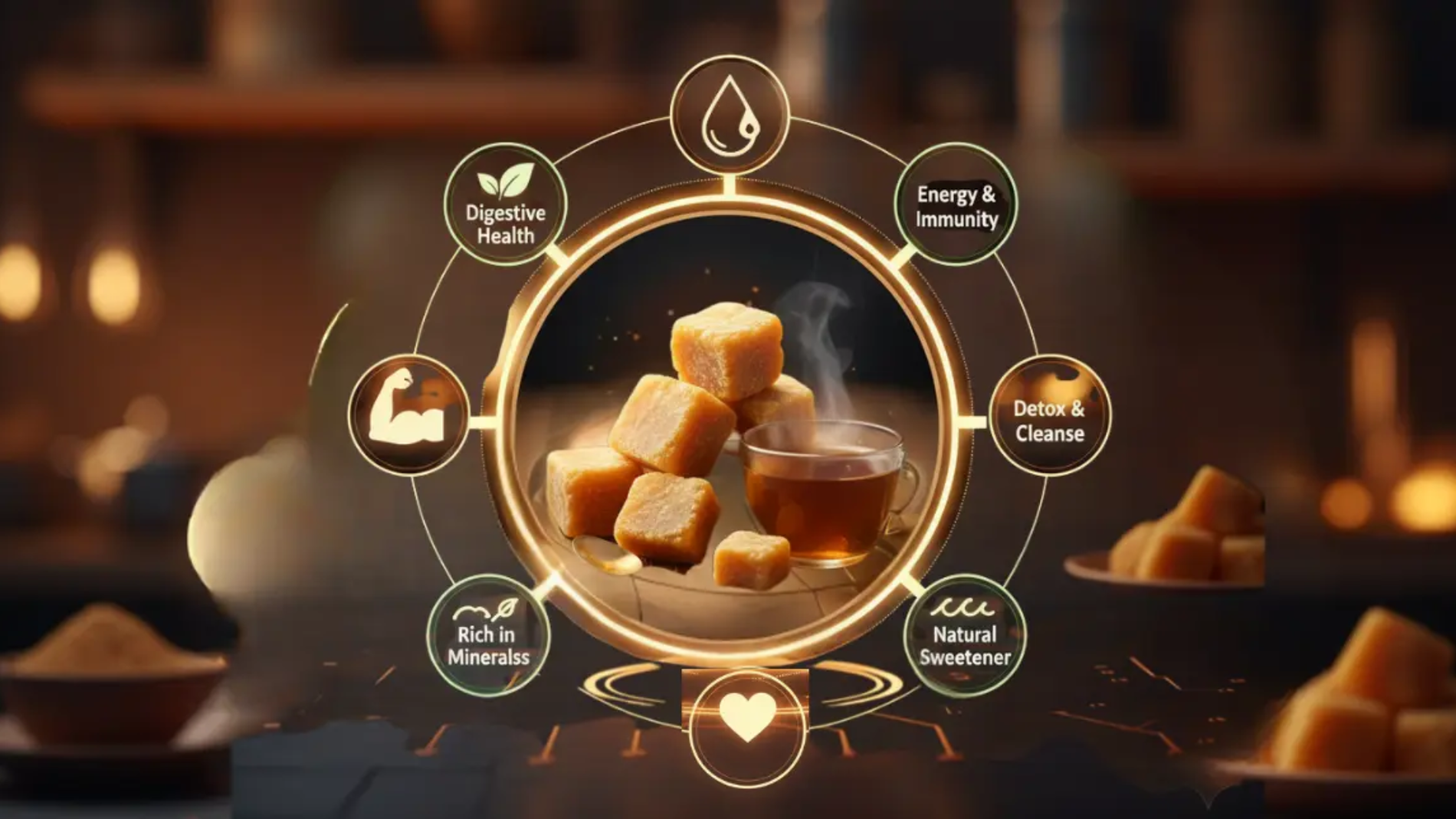
The reason jaggery is revered in Ayurveda and traditional medicine lies in its impressive nutritional profile. Here are some of the key jaggery health benefits.

1. A Rich Source of Essential Minerals This is jaggery’s primary advantage over “empty calorie” sweeteners. It is a mineral-rich sweetener containing:

  • Iron: Jaggery is a well-known plant-based source of iron. Regular consumption can help prevent iron-deficiency anemia and boost energy levels.

  • Magnesium: Important for nerve function, muscle health, and strengthening the nervous system.

  • Potassium: Helps maintain electrolyte balance and manage blood pressure.

Spice Up Your Business with Authentic Indian Flavors

Import and Export Excellence from India!

2. Acts as a Natural Digestive Aid For generations, it has been a common practice in India to consume a small piece of jaggery after a meal. This isn’t just to satisfy a sweet tooth; jaggery is known to activate digestive enzymes in the body, helping to promote smooth digestion and prevent constipation.

3. A Natural Body Cleanser and Detoxifier In traditional wellness practices, jaggery is considered a natural blood purifier. It is believed to help cleanse the liver by flushing out harmful toxins from the body. This detoxifying property makes it a prized Ayurvedic ingredient for overall health and well-being.

4. A Source of Sustained Energy While it is a sugar, jaggery is a complex carbohydrate. This means it is digested and absorbed more slowly by the body compared to simple refined sugar. The result is a more gradual and sustained release of energy, helping to avoid the sudden “sugar rush” and subsequent energy crash.

The Challenge of Cubes and the Easy Solution: Jaggery Powder

While the health benefits are undeniable, the traditional form of Indian Jaggery Cubes presents a practical challenge for daily use. The blocks are hard, difficult to break, sticky to handle, and a nightmare to measure accurately for recipes. Trying to dissolve a hard cube in a cold smoothie or a bowl of yogurt is nearly impossible.

This is where modern innovation provides a perfect solution: Jaggery Powder.

Jaggery powder is simply the same wholesome jaggery, further processed into a convenient, free-flowing, granulated form. It contains all the same health benefits, minerals, and rich caramel flavour as the cubes, but without any of the hassle.

The powder format makes it incredibly simple to make jaggery a part of your daily routine. You can stir it into your morning coffee, blend it into a post-workout shake, sprinkle it on your oatmeal, or use it in baking with perfect, consistent results every time.

Spice Up Your Business with Authentic Indian Flavors

Import and Export Excellence from India!

Indian Jaggery Cubes are a testament to the traditional wisdom of using whole, unrefined foods. They offer a wealth of health benefits that refined sugar simply cannot match. However, for a modern, convenient lifestyle, jaggery powder is the clear winner, providing the easiest and most versatile way to enjoy this ancient superfood daily.

Frequently Asked Questions (FAQs)

1. Are jaggery cubes healthier than jaggery powder? No. As long as both are pure and made without chemicals, they have the exact same nutritional value and health benefits. The only difference is the physical form.

2. How much iron is in jaggery? While it varies, jaggery is considered one of the best plant-based sources of iron. Regular, moderate consumption can contribute significantly to your daily iron intake.

3. Is jaggery a good remedy for coughs and colds? In traditional Indian medicine, jaggery is often consumed with ginger or black pepper to soothe a sore throat and help clear the respiratory tract due to its warming properties.

4. How is jaggery different from brown sugar? Brown sugar is typically refined white sugar with molasses added back in for colour and flavour. Jaggery is unrefined, evaporated sugarcane juice, meaning none of the natural minerals are ever stripped away.

5. Can people with diabetes consume jaggery? While it is more nutritious than white sugar, jaggery still has a high sucrose content and will raise blood sugar levels. People with diabetes should consume it with caution and consult their doctor.

6. Can I make jaggery powder from cubes at home? You can, by grating the hard block or breaking it up in a powerful blender. However, it is a laborious process, and the result is often not as fine or free-flowing as commercially produced powder.

7. Why do some jaggery cubes look very dark? The colour of jaggery can range from golden-yellow to dark brown. This depends on the sugarcane variety and the duration of boiling. A darker colour often indicates a richer, more molasses-like flavour.

8. How much jaggery is safe to consume daily? When used as a substitute for refined sugar, moderate consumption of about 10-20 grams per day is generally considered healthy as part of a balanced diet.

About us

We bridge the gap between local producers and global markets, ensuring seamless trade facilitation with exceptional quality and reliability. We provide quick delivery services with customized packaging with all approval of International Certificates (Spices board India, MSME, IEC, fssai, FIEO, APEDA, EU certification, FDA and Many More)

Contact us

Shop No. 3, Ganesh Prestige Sr. No. 2/15, Near Laxmi Jewellers, Dhanakawadi, Pune – 411043, Maharashtra INDIA.

Call On

+91 9545205050

+91 9822422584
Email

sales@aquaconnectexim.com

aquaconnectexim@gmail.com

Indian Nilgiri Green Tea powder

Sourcing Success: 5 Quality Markers for Premium Indian Nilgiri Green Tea

In the vast world of tea, India offers a trifecta of legendary origins: the robust strength of Assam, the delicate muscatel of Darjeeling, and the fragrant, aromatic jewel of the south—Nilgiri. While it may sometimes be the quietest of the three stars, for discerning importers and specialty brands, Indian Nilgiri Green Tea represents a unique and highly sought-after profile.

Sourcing this tea successfully, however, requires looking beyond the name. It demands an understanding of the specific characteristics that define its premium quality. As an experienced exporter with deep connections in India’s tea trade, we’ve identified the five critical quality markers that every serious buyer must look for.

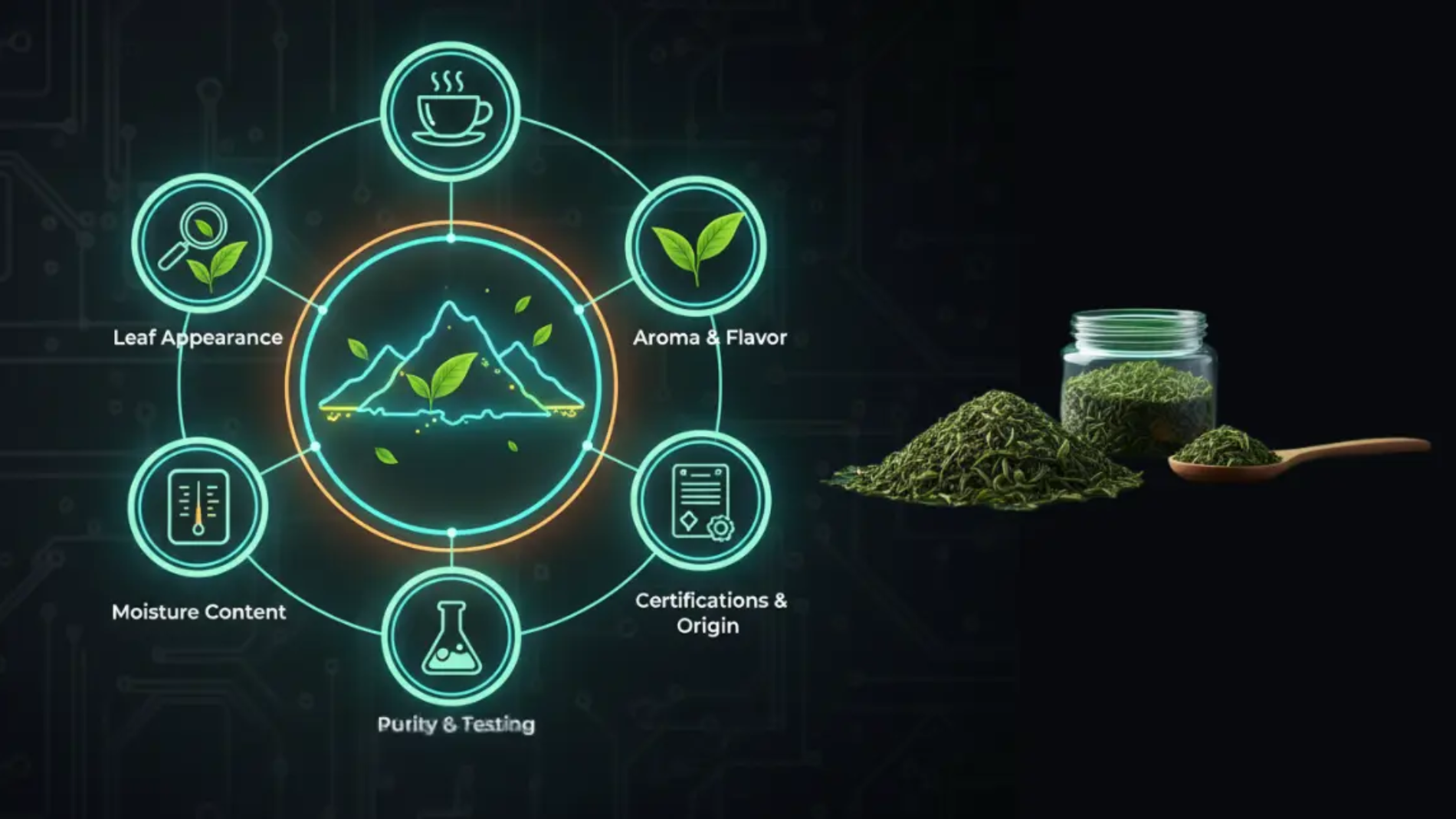
1. The Unmistakable Aroma: Fragrance is Paramount

The first and most defining characteristic of premium Nilgiri tea is its aroma. Unlike the grassy notes of some green teas or the malty power of Assam, a high-quality Nilgiri boasts a beautifully fragrant, floral, and often fruity bouquet.

What to look for:

  • A bright, lively, and intensely aromatic fragrance right out of the package.

  • Complex notes of flowers, tropical fruits, and a hint of sweet spice.

This exceptional aroma is a direct result of the high-altitude terroir of the tea from the Blue Mountains. If the aroma is flat, dusty, or weak, it’s a clear sign of an inferior or old product. For a brand, this fragrance is a key selling point.

Spice Up Your Business with Authentic Indian Flavors

Import and Export Excellence from India!

2. The Visual Cues: A Vibrant, Clean Appearance

Before you even brew it, the dry powder or leaf tells a story. Premium Indian Nilgiri Green Tea should be vibrant and clean in appearance.

What to look for:

  • For Powder: A bright, consistent green colour. A fine, uniform particle size (mesh size) is also crucial for applications like beverages, ensuring a smooth texture.

  • For Leaf: Well-rolled, whole or broken leaves that are uniform in size and colour.

What to avoid:

  • A dull, brownish, or yellowish hue. This indicates oxidation, over-processing, or old age, which means the delicate antioxidant compounds like EGCG have likely degraded.

3. The Smoothness Factor: The Low Tannin Advantage

One of the most significant commercial advantages of Nilgiri tea is that it is a naturally low tannin tea. Tannins are the polyphenolic compounds responsible for the bitterness and astringency (the dry, puckering sensation) in many teas.

What to look for:

  • A taste that is incredibly smooth, brisk, and clean on the palate.

  • A lack of a harsh, bitter aftertaste, even if slightly over-steeped.

This “forgiving” nature makes it exceptionally appealing to a broad range of consumers. It’s also the reason why Nilgiri is the number one choice for iced tea, as the low tannin content prevents the liquid from turning cloudy or “creaming down” when chilled.

4. The Origin Story: Traceability to the Blue Mountains

Authenticity is everything. True Indian Nilgiri Green Tea is grown exclusively in the high-altitude Nilgiri district of Tamil Nadu. This unique terroir, with its year-round harvest cycle, is what gives the tea its signature character.

What to look for:

  • A supplier who can provide clear traceability back to the specific tea estates or region within the Nilgiris.

  • Knowledge of the harvest seasons. While it’s a year-round crop, the teas plucked during the cool, dry winter months (our peak season, which is just around the corner) are often considered the most fragrant and flavourful.

A supplier who can speak with authority about the origin of their tea is a supplier you can trust.

Spice Up Your Business with Authentic Indian Flavors

Import and Export Excellence from India!

5. The Proof in the Paperwork: The Certificate of Analysis (COA)

For any spice importer or bulk buyer, this is the final and most critical checkpoint. A Certificate of Analysis from a third-party lab is your scientific guarantee of quality and safety.

What to look for in a COA:

  • Microbiological Safety: Confirmation that the tea is free from harmful bacteria, yeast, and mould.

  • Heavy Metal Analysis: Verification that levels of lead, arsenic, etc., are within safe limits for your target market (e.g., FDA or EU standards).

  • Moisture Content: A low moisture level is essential for ensuring a long and stable shelf life.

  • Potency (Optional but Recommended): For nutraceutical or functional food applications, a COA can also verify the total polyphenol or EGCG content.

By focusing on these five markers, you move beyond simply buying a commodity and begin sourcing a truly premium, authentic, and valuable ingredient.

Frequently Asked Questions (FAQs)

1. How does the taste of Nilgiri green tea differ from Darjeeling?

Both are delicate and aromatic, but they have distinct characters. Darjeeling often has a famous “muscatel” grape-like note and a more pronounced, prized astringency. Nilgiri is typically smoother, more fragrant with floral and fruity notes, and less astringent.

2. Why is Nilgiri tea so good for iced tea?

Its naturally low tannin content is the key. Tannins in other black and green teas bind together and precipitate when the tea is chilled, causing a cloudy or murky appearance. Nilgiri tea remains crystal clear.

3. What are tannins in tea?

Tannins are a type of polyphenol compound that contributes to the astringency and bitterness of tea. While they have antioxidant properties, high levels can be unpleasant for some palates.

4. What is the best way to brew Nilgiri green tea to appreciate its flavour?

Use water that is well below boiling (around 80°C or 176°F) and steep for only 2-3 minutes. This will extract its delicate, fragrant notes without any bitterness.

5. Is Nilgiri green tea suitable for making lattes?

While possible, its flavour is quite delicate. For a green tea latte where the flavour needs to stand up to milk, a bolder green tea like an Assam green tea is often a better choice.

6. Does Nilgiri green tea have as many health benefits as other green teas?

Yes. It is rich in the same beneficial antioxidants, particularly catechins like EGCG, that are found in all high-quality green teas and are associated with numerous health benefits.

7. Can I get certified organic Indian Nilgiri Green Tea?

Absolutely. Many estates in the Nilgiri region follow organic farming practices. Sourcing a certified organic variety is an excellent way to guarantee purity and appeal to health-conscious consumers.

8. What should I ask a potential green tea supplier?

Ask for their latest harvest samples, a batch-specific Certificate of Analysis (COA), their organic certifications, and details about the specific region or estate where the tea was grown.

About us

We bridge the gap between local producers and global markets, ensuring seamless trade facilitation with exceptional quality and reliability. We provide quick delivery services with customized packaging with all approval of International Certificates (Spices board India, MSME, IEC, fssai, FIEO, APEDA, EU certification, FDA and Many More)

Contact us

Shop No. 3, Ganesh Prestige Sr. No. 2/15, Near Laxmi Jewellers, Dhanakawadi, Pune – 411043, Maharashtra INDIA.

Call On

+91 9545205050

+91 9822422584

Email

sales@aquaconnectexim.com

aquaconnectexim@gmail.com