

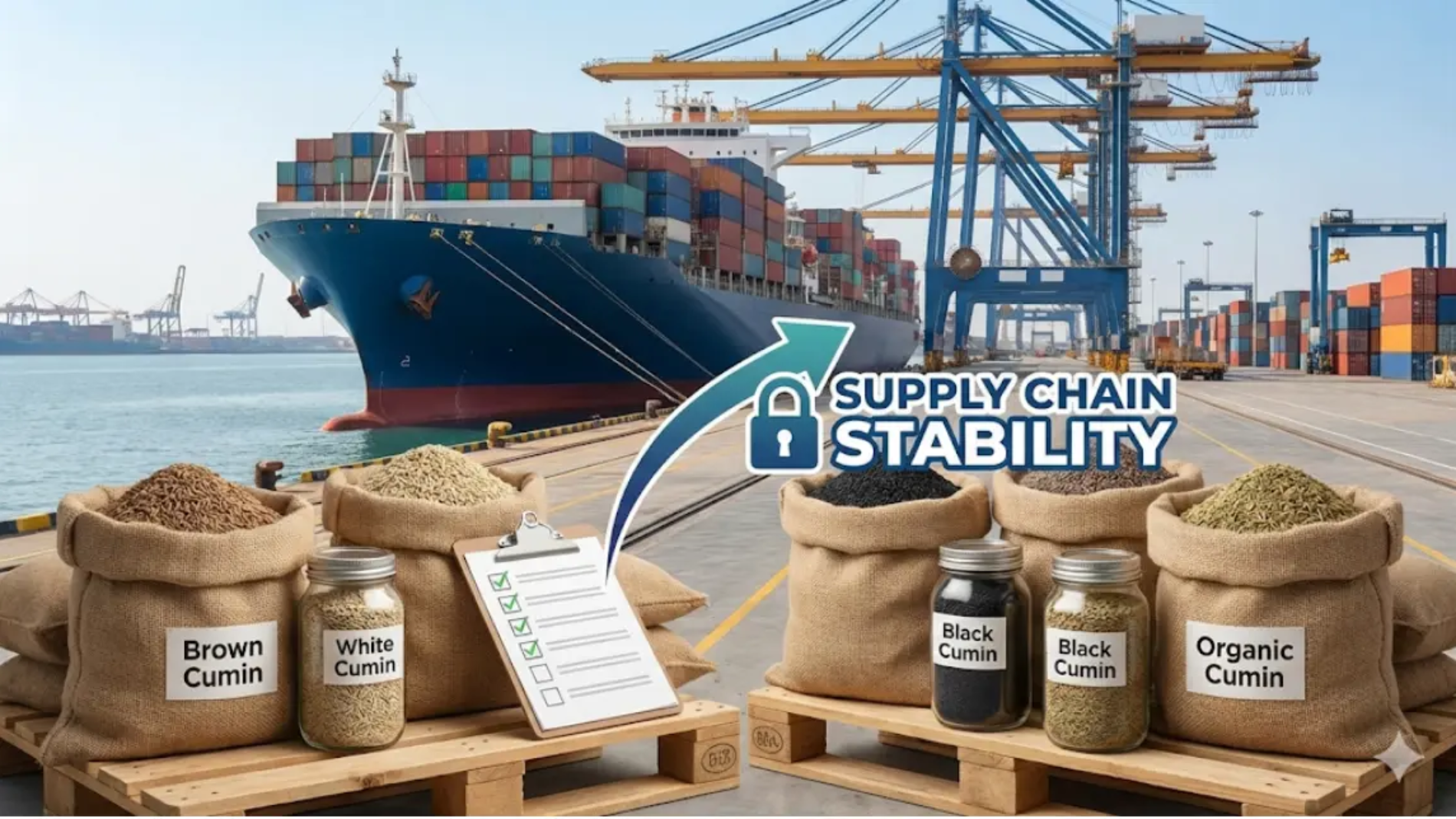
In the volatile world of international agri-commodities, supply chain stability is the bedrock of a successful business. For food manufacturers, spice blenders, and wholesalers, a disruption in the supply of key ingredients can halt production lines and erode profit margins. Cumin, the second most popular spice in the world after pepper, is a staple in global cuisines. However, not all types of cumin seeds offer the same reliability when it comes to bulk sourcing.
Geopolitical tensions, climate change, and fluctuating harvest yields in major producing countries like Syria and Turkey have made sourcing challenging. In this landscape, India has emerged as the most reliable global supplier. But even within Indian exports, understanding the nuances between the different types of cumin seeds—Brown, White, Black, and Organic—is crucial for securing a consistent, year-round supply.
Here is a breakdown of the major types of cumin seeds and processed forms, analyzed through the lens of supply chain stability for importers.
1. Brown Cumin Seeds: The Industrial Standard
When the world talks about “cumin,” they are almost always referring to Brown Cumin Seeds (Cuminum cyminum). This is the workhorse of the spice industry.
Supply Chain Verdict: Highly Stable. As the most widely cultivated variety, particularly in the Indian states of Gujarat and Rajasthan, brown cumin offers the highest liquidity in the market. There is ample volume available year-round, minimizing the risk of stockouts.
Best For: Large-scale curry powder manufacturers, oleoresin extraction, and essential oil distillers.
Importer Note: Because this is a high-volume commodity, prices are transparent. Importers can hedge against volatility by locking in contracts during the peak harvest season (February to April).
2. White Cumin Seeds: The Premium Grade
There is often confusion among buyers regarding White Cumin Seeds. In the botanical sense, standard cumin is often called “Safed Jeera” (White Cumin) in India to distinguish it from the unrelated Black Cumin. However, in the export trade, “White Cumin” often refers to premium, machine-cleaned, or Sortex-graded seeds that have a lighter, brighter color compared to the standard unpolished brown seeds.
Supply Chain Verdict: Stable but Price-Sensitive. Since these are essentially high-quality processed versions of brown cumin, the supply is stable. However, the extra processing (Sortex cleaning) adds a layer of cost.
Best For: Retail packing, grocery chains, and visible applications (like bakery toppings) where visual purity is paramount.
Importer Note: “Singapore Quality” (99% pure) and “Europe Quality” (99.5% pure) are the benchmarks here. Europe Quality is the most stable choice for Western markets due to strict pesticide residue compliance.
Spice Up Your Business with Authentic Indian Flavors
Import and Export Excellence from India!
3. Black Cumin Seeds: The Niche Specialty
Black Cumin Seeds are distinct from the standard variety. Depending on the region, this term can refer to Nigella sativa (Kalonji) or Bunium bulbocastanum (Kala Jeera/Shah Jeera). In the context of premium spice blends (like Garam Masala), it usually refers to the latter—a smaller, darker, sweeter seed.
Supply Chain Verdict: Volatile. Unlike the massive cultivation of brown/white cumin, Black Cumin Seeds are grown in much smaller quantities, often in specific mountainous or wild regions (like the Himalayas or parts of Iran/Pakistan/India).
Best For: Gourmet spice blends, authentic Mughlai cuisine, and medicinal herbal products.
Importer Note: Due to lower production volumes, this type is susceptible to price spikes if a single harvest fails. It is not recommended to build a high-volume, low-margin product line solely around this variety without securing a dedicated supplier first.
4. Organic Cumin Seeds: The Growing Demand
With the “Clean Label” movement gaining momentum, the demand for Organic Cumin Seeds is outstripping supply. These are grown without synthetic fertilizers or pesticides and come with certifications (USDA, EU Organic, NPOP).
Supply Chain Verdict: Moderate to Tight. While India is increasing its organic acreage, the conversion process for farmland takes three years. This creates a supply lag.
Best For: Health food brands, baby food manufacturers, and premium organic retailers.
Importer Note: Stability here depends entirely on the supplier’s certifications. Verify traceability. Buying organic cumin seeds on the spot market is risky; long-term contracts with certified exporters are essential to ensure you don’t face shortages.
5. Cumin Powder: The Convenience vs. Shelf-Life Trade-off
While not a “seed” strictly speaking, Cumin Powder is a major export category. Many importers debate whether to import the raw seed or the finished powder.
Supply Chain Verdict: Stable, but Logistically Demanding. The supply of powder is as stable as the brown seeds it is ground from. However, the stability challenge here is shelf life. Powder oxidizes faster than whole seeds.
Best For: Instant spice mixes, ready-to-eat (RTE) meals, and sauce manufacturing.
Importer Note: Importing powder saves on local processing costs but requires high-barrier packaging to preserve volatile oils. For long-distance shipping (e.g., India to South America), importing whole types of cumin seeds and grinding locally is often the safer strategy for freshness.
Spice Up Your Business with Authentic Indian Flavors
Import and Export Excellence from India!
Making the Right Choice
For bulk importers, the “best” type of cumin depends on your risk tolerance and end application.
For maximum stability and lowest cost: Choose Brown Cumin Seeds.
For retail and visual appeal: Choose White Cumin Seeds (Europe Grade).
For specialty niches: Source Black Cumin, but keep inventory buffers high.
For high-value markets: Secure contracts for Organic Cumin Seeds.
By understanding the production dynamics of these different types of cumin seeds, you can build a resilient supply chain that withstands market fluctuations.
Frequently Asked Questions (FAQs)
1. What is the difference between Brown and White Cumin Seeds?
Botanically, they are usually the same plant (Cuminum cyminum). In the trade, “Brown” refers to the standard unpolished crop, while “White” often refers to higher quality, polished, or Sortex-cleaned seeds that appear lighter and brighter.
2. Is Black Cumin the same as Nigella (Kalonji)?
This is a common confusion. In Indian cooking, Nigella sativa is often called “Kalonji” or Onion Seed, but sometimes marketed as Black Cumin. True Black Cumin (Bunium bulbocastanum or Shah Jeera) is a different, thinner, curved seed used in biryanis. Always clarify the botanical name with your supplier.
3. Which type of cumin seed has the highest oil content?
Generally, standard Brown/White cumin seeds grown in India have a volatile oil content between 2.5% to 4%. This is ideal for flavor. Specific regions (like Gujarat) are known for high-oil seeds suitable for extraction.
4. Why is Organic Cumin more expensive? Organic farming is labor-intensive and has lower yields per acre compared to conventional farming. Additionally, the cost of certification and strict separation during processing adds to the premium price.
5. Can I store Cumin Powder as long as Cumin Seeds?
No. Whole types of cumin seeds can retain their flavor for up to 2 years if stored correctly. Cumin powder loses its potency much faster (6-12 months) because the surface area is exposed to air, leading to oxidation of essential oils.
6. What is “Europe Quality” cumin?
“Europe Quality” refers to cumin seeds that have been processed to 99.5% purity (free from stems/stones) and tested to meet strict European Union regulations regarding pesticide residues (IPM Cumin).
7. Is it better to import whole seeds or powder?
For supply chain stability and quality control, importing whole cumin seeds is usually better. It allows you to grind on demand, ensuring freshness for your customers. Powder is better only if you lack grinding infrastructure.
8. Which country is the most stable supplier of cumin?
India produces over 70% of the world’s cumin and consumes a large portion of it, meaning the market infrastructure is massive and robust. Compared to Syria or Turkey, India offers the most stable supply of all types of cumin seeds.
About us
We bridge the gap between local producers and global markets, ensuring seamless trade facilitation with exceptional quality and reliability. We provide quick delivery services with customized packaging with all approval of International Certificates (Spices board India, MSME, IEC, fssai, FIEO, APEDA, EU certification, FDA and Many More)
Contact us
Shop No. 3, Ganesh Prestige Sr. No. 2/15, Near Laxmi Jewellers, Dhanakawadi, Pune – 411043, Maharashtra INDIA.
Call On
+91 9545205050
+91 9822422584
Leave A Comment