

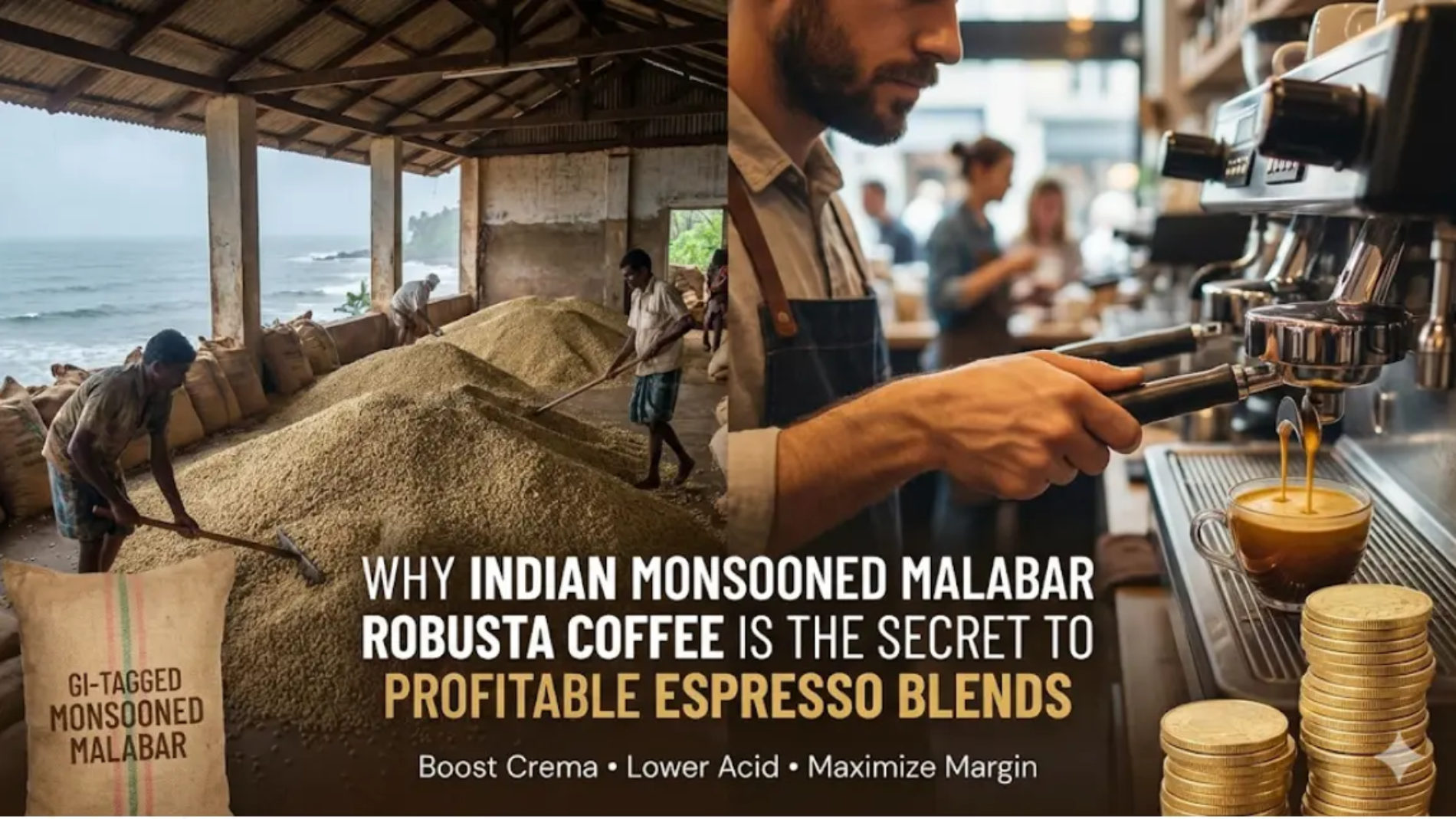
In the competitive landscape of the global coffee trade, master roasters and wholesale coffee importers are constantly searching for the “holy grail” of ingredients: a bean that enhances quality while protecting profit margins. In 2026, the industry has turned its eyes toward a specialty origin that once happened by accident but is now crafted with precision-Monsooned Malabar Robusta Coffee.
While Arabica often takes the spotlight for its delicate acidity, the secret to a world-class espresso that stands up to milk and sugar often lies in high-quality Robusta. Indian Monsooned Malabar Robusta Coffee is not just a filler; it is a functional powerhouse that provides the body, crema, and smoothness required for a signature blend.
The Science of the Monsoon: A Transformation Like No Other
The journey of Monsooned Malabar Robusta Coffee begins with a 12-to-16-week curing process along the Malabar Coast of India. During the Southwest Monsoon months of June through September, dry-processed Robusta beans are exposed to moisture-laden sea winds in open-sided warehouses.
This exposure causes a dramatic physical and chemical metamorphosis:
Swelling and Density: The beans absorb moisture from the humid air, nearly doubling in size and significantly losing density.
Color Change: The initial golden-brown cherry beans transform into a distinct pale golden or straw hue.
Acidity Reduction: The process neutralizes the bean’s pH, making it one of the lowest acidity coffees in the world.
For a roaster, this means a bean that is exceptionally mellow and “soft” on the palate, lacking the aggressive “rubbery” notes typically associated with standard Robusta.
The "Crema Factor": Visual Appeal that Sells
In the world of professional baristas, the visual appeal of an espresso shot—its crema—is a hallmark of quality. Monsooned Malabar Robusta Coffee is arguably the most efficient crema-producer available to the trade.
Because of its unique cellular structure after monsooning, this coffee produces a dense, persistent, and “tiger-striped” crema that can account for up to 80% of the shot volume. This is a massive advantage for coffee brands. A thick crema not only holds sugar but also creates a syrupy, buttery mouthfeel that defines the “Italian-style” espresso profile that is dominating global markets.
Balancing the Blend: The "Mellowing" Effect
Many high-end Arabicas from Africa or Latin America are prized for their bright, citrusy acidity. However, as a single origin, these can sometimes be too sharp for the average consumer’s palate.
Monsooned Malabar Robusta Coffee acts as the perfect structural “glue” for a blend. Its earthy, nutty, and chocolatey low-notes balance out the high-acidity “bright” coffees. By using a 15–30% inclusion of Indian Monsooned Robusta, roasters can create a cup that is complex yet smooth and approachable.
Profitability and Market Value: The GI Tag Advantage
From a business perspective, Monsooned Malabar Robusta Coffee offers a significant B2B coffee sourcing advantage. India holds a Geographical Indication (GI) tag for this specialty coffee, ensuring its unique status and premium value in international trade.
Despite being a specialty “super grade,” Robusta generally offers an incredible price-to-quality ratio compared to high-end washed Arabicas. By strategically incorporating this Indian specialty coffee into their offerings, brands can achieve:
Reduced Cost per Batch: Lowering the overall cost of the blend without sacrificing the sensory experience.
Higher Solubility: Robusta’s high soluble solids make it excellent for high-extraction rates in commercial machines.
Niche Positioning: Marketing a “GI-Tagged” or “Monsooned” blend allows for premium shelf pricing.
Sourcing Excellence: Grades and Roasting
When sourcing bulk coffee beans from India, roasters should look for the Robusta AA grade. These are larger, well-sorted beans that ensure a uniform roast.
Roasting Tip: Because monsooned beans are less dense, they require a lower drum charge temperature. A Medium-Dark roast is generally the “sweet spot,” bringing out rich notes of dark chocolate, spice, and toasted grain without introducing bitterness.
Transforming Your Coffee Business
In 2026, Roasted Coffee Powder from India is dominating global markets because it delivers what modern consumers want: low acidity, sustainable stories, and a powerful sensory kick. By making Monsooned Malabar Robusta Coffee a core component of your espresso strategy, you aren’t just improving your coffee—you are engineering a more profitable and stable business model.
Frequently Asked Questions (FAQs)
1. Is Monsooned Malabar Robusta real coffee or an aged product?
It is fresh, seasonal coffee. The “aged” flavor is a result of the monsooning process, which mimics the 19th-century journey when beans were exposed to sea winds for months.
2. Why is it so popular for espresso blends?
It is prized for its ability to create a thick, stable espresso crema and a heavy, syrupy body that Arabica alone often cannot provide.
3. Does it have more caffeine than Arabica?
Yes. Like most Robusta, it has approximately twice the caffeine content (around 2.2% to 2.7%) compared to Arabica, making it perfect for “wake up” blends.
4. What does the “GI Tag” mean for buyers?
It stands for Geographical Indication. It guarantees that the coffee was authentically processed along India’s Malabar Coast using traditional methods, ensuring a specific quality standard.
5. How does the flavor compare to regular Robusta?
It is much mellower. While standard Robusta can be harsh, the monsooning process neutralizes acidity and adds notes of spice, cocoa, and earthiness.
6. Can it be used as a single-origin coffee?
Absolutely. Many connoisseurs enjoy it in a Moka Pot or French Press specifically for its creamy body and low-acid, stomach-friendly properties.
7. Is the monsooning process sustainable?
Yes. It is a low-impact processing method that relies on natural winds rather than heavy water usage or chemicals, making it attractive to eco-conscious importers.
8. What is the shelf life of green Monsooned Malabar Robusta?
When stored in cool, dry conditions in jute bags with HDPE liners, it typically has a shelf life of 12 to 18 months.
About us
We bridge the gap between local producers and global markets, ensuring seamless trade facilitation with exceptional quality and reliability. We provide quick delivery services with customized packaging with all approval of International Certificates (Spices board India, MSME, IEC, fssai, FIEO, APEDA, EU certification, FDA and Many More)
Contact us
Shop No. 3, Ganesh Prestige Sr. No. 2/15, Near Laxmi Jewellers, Dhanakawadi, Pune – 411043, Maharashtra INDIA.
Call On
+91 9545205050
+91 9822422584
Leave A Comment