

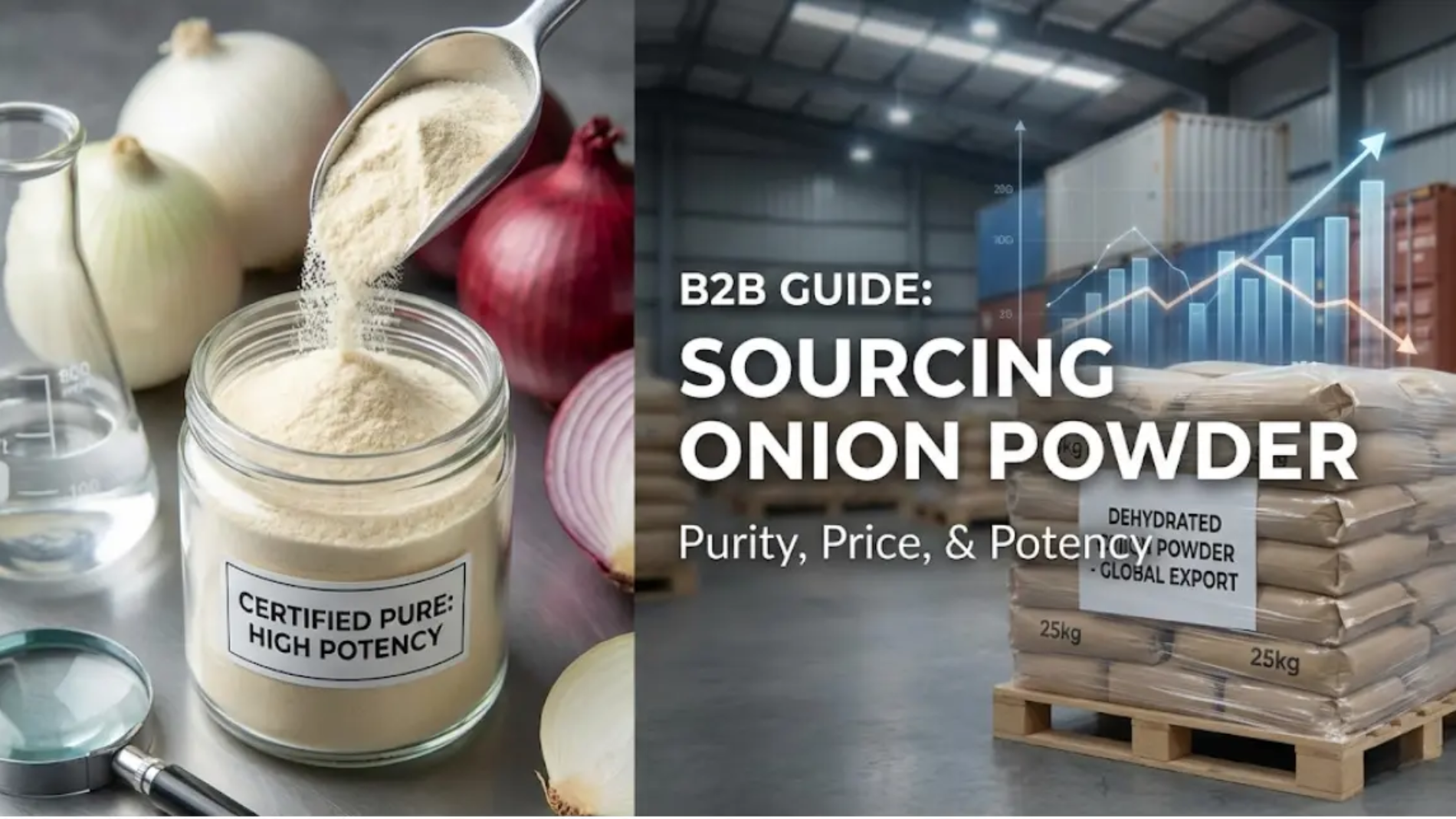
In the global food manufacturing and seasoning industry, onion powder is more than just a kitchen staple—it is a critical industrial ingredient. From snack flavorings and meat processing to ready-to-eat meals, the quality of your onion powder can determine the shelf life and flavor profile of your entire product line.
However, for procurement managers and business owners, Sourcing Onion Powder at a commercial scale involves navigating a complex landscape of varieties, drying technologies, and microbiological standards. This guide breaks down the essential factors of purity, price, and potency to help you secure the best wholesale supply.
Understanding the Varieties: White vs. Red Onion Powder
The first step in Sourcing Onion Powder is choosing the right base material. While both are used extensively, they serve different industrial purposes.
White Onion Powder: This is the industry standard for most spice blends and soups. White onions have a higher solid content, which results in a more pungent, concentrated flavor when dehydrated. It provides a clean, savory profile without altering the color of the final product.
Red Onion Powder: Often sought for its slightly sweeter undertones and darker hue. It is frequently used in specialty spice rubs or ethnic food formulations where a deeper color and a specific “toasted” flavor profile are required.
When sourcing, ensure you specify the variety, as the flavor potency and price per kilogram can vary significantly between the two.
Dehydration Methods: Preserving Potency
The method used to turn a fresh bulb into a fine powder dictates the potency of the ingredient. Most bulk onion powder is produced using controlled dehydration.
The process involves cleaning, chopping, drying, and then milling the onions into various fractions (kibbled, minced, or powder). The “Gold Standard” in dehydrated onion powder is achieved when the drying temperature is strictly monitored to prevent caramelization. If the onion is dried at too high a temperature, the volatile oils—responsible for that signature “bite”—are lost, leaving you with a powder that is visually correct but chemically weak.
Spice Up Your Business with Authentic Indian Flavors
Import and Export Excellence from India!
Dehydration Methods: Preserving Potency
The method used to turn a fresh bulb into a fine powder dictates the potency of the ingredient. Most bulk onion powder is produced using controlled dehydration.
The process involves cleaning, chopping, drying, and then milling the onions into various fractions (kibbled, minced, or powder). The “Gold Standard” in dehydrated onion powder is achieved when the drying temperature is strictly monitored to prevent caramelization. If the onion is dried at too high a temperature, the volatile oils—responsible for that signature “bite”—are lost, leaving you with a powder that is visually correct but chemically weak.
The Three Pillars of Quality: What to Check in a COA
When you are Sourcing Onion Powder from an exporter or manufacturer, the Certificate of Analysis (COA) is your most important document. Pay close attention to these three metrics:
1. Moisture Content
High-quality onion powder wholesale should have a moisture content between 4% and 6%. Onion powder is highly hygroscopic, meaning it absorbs moisture from the air rapidly. If the starting moisture is too high, the powder will “cake” (turn into hard lumps) inside your warehouse, making it impossible to use in automated filling lines.
2. Particle Size (Mesh)
For seasonings and dry rubs, a fine mesh (usually 60-100 mesh) is preferred for even distribution. For soups or sauces where the onion is meant to rehydrate and provide texture, you might look for “minced” or “granulated” versions rather than a fine powder.
3. Microbiological Purity
Onions grow in the soil, which makes them susceptible to microbes like Salmonella, E. Coli, and Yeast/Mold. Ensure your supplier uses validated treatment methods, such as Steam Sterilization or Gamma Irradiation, to ensure the powder is safe for human consumption without degrading the flavor.
Navigating the Price: Wholesale Economics
When Sourcing Onion Powder, the lowest price is rarely the best deal. “Cheap” onion powder is often adulterated with fillers like cornstarch or maltodextrin to increase bulk.
Purity Check: Pure onion powder should have a strong, lingering aroma. If the powder is odorless or has a chalky texture, it has likely been diluted.
Origin Matters: India is one of the largest producers of high-quality dehydrated onions. Sourcing directly from an Indian exporter often provides a better balance of price and potency compared to buying through multiple layers of middle-market distributors.
Private Label and Custom Blends
Many businesses today are looking for Private Label Onion Powder solutions. This involves more than just putting a logo on a bag. A reliable sourcing partner should be able to offer:
Custom Grinds: Adjusting the mesh size to fit your specific shaker or industrial mixer.
Packaging Options: From 25kg bulk bags for industrial use to retail-ready 100g jars.
Traceability: Ensuring the onions can be traced back to the farm level, which is a growing requirement for food safety audits in Europe and North America.
Spice Up Your Business with Authentic Indian Flavors
Import and Export Excellence from India!
Private Label and Custom Blends
Effective Sourcing Onion Powder requires a balance of technical knowledge and market savvy. By focusing on high-solids white onions, ensuring low moisture levels, and insisting on microbiological safety, you can secure an ingredient that enhances your product’s quality.
Whether you are a spice packer or a large-scale food manufacturer, the potency of your onion powder is the “invisible” ingredient that keeps your customers coming back for more.
Frequently Asked Questions (FAQs)
1. Why does my onion powder turn into hard lumps?
Onion powder is hygroscopic, meaning it absorbs atmospheric moisture. This “caking” happens if the packaging is not airtight or if the storage area is too humid. Always source powder with a moisture content below 6% and store it in a cool, dry place.
2. What is the difference between onion powder and onion salt?
Onion powder is 100% dehydrated and ground onion. Onion salt is a blend, typically consisting of three parts salt and one part onion powder. For industrial food production, it is almost always better to source pure onion powder wholesale to maintain control over your sodium levels.
3. Is “Dehydrated Onion Powder” the same as fresh onion?
In terms of flavor, one tablespoon of onion powder is roughly equivalent to one medium fresh onion. However, powder provides a more uniform distribution of flavor and a longer shelf life, making it superior for industrial applications.
4. How can I tell if the onion powder is pure?
Pure onion powder has a distinct, pungent aroma and a slightly off-white to creamy color. If it is pure white and has a very mild smell, it may contain anti-caking agents or fillers like starch.
5. What is the shelf life of bulk onion powder?
If stored in unopened, moisture-proof packaging, wholesale onion powder can last for 18 to 24 months. Once opened, it should be used quickly or resealed in an airtight container.
6. Does your onion powder undergo Steam Sterilization?
Yes, most export-grade onion powder is steam-sterilized to reduce the microbial load while preserving the color and volatile oil content. This is essential for meeting international food safety standards (like FDA or EU regulations).
7. Can I get custom mesh sizes for my seasoning brand?
Yes. Manufacturers can adjust the milling process to provide anything from a fine “flour-like” powder to a coarser granulated texture, depending on your product’s needs.
8. Is Indian onion powder better than others?
India is a global leader in onion dehydration due to the high-solid varieties grown locally. This results in a powder with higher flavor potency and better rehydration properties compared to varieties grown in cooler climates.
About us
We bridge the gap between local producers and global markets, ensuring seamless trade facilitation with exceptional quality and reliability. We provide quick delivery services with customized packaging with all approval of International Certificates (Spices board India, MSME, IEC, fssai, FIEO, APEDA, EU certification, FDA and Many More)
Contact us
Shop No. 3, Ganesh Prestige Sr. No. 2/15, Near Laxmi Jewellers, Dhanakawadi, Pune – 411043, Maharashtra INDIA.
Call On
+91 9545205050
+91 9822422584
Leave A Comment