

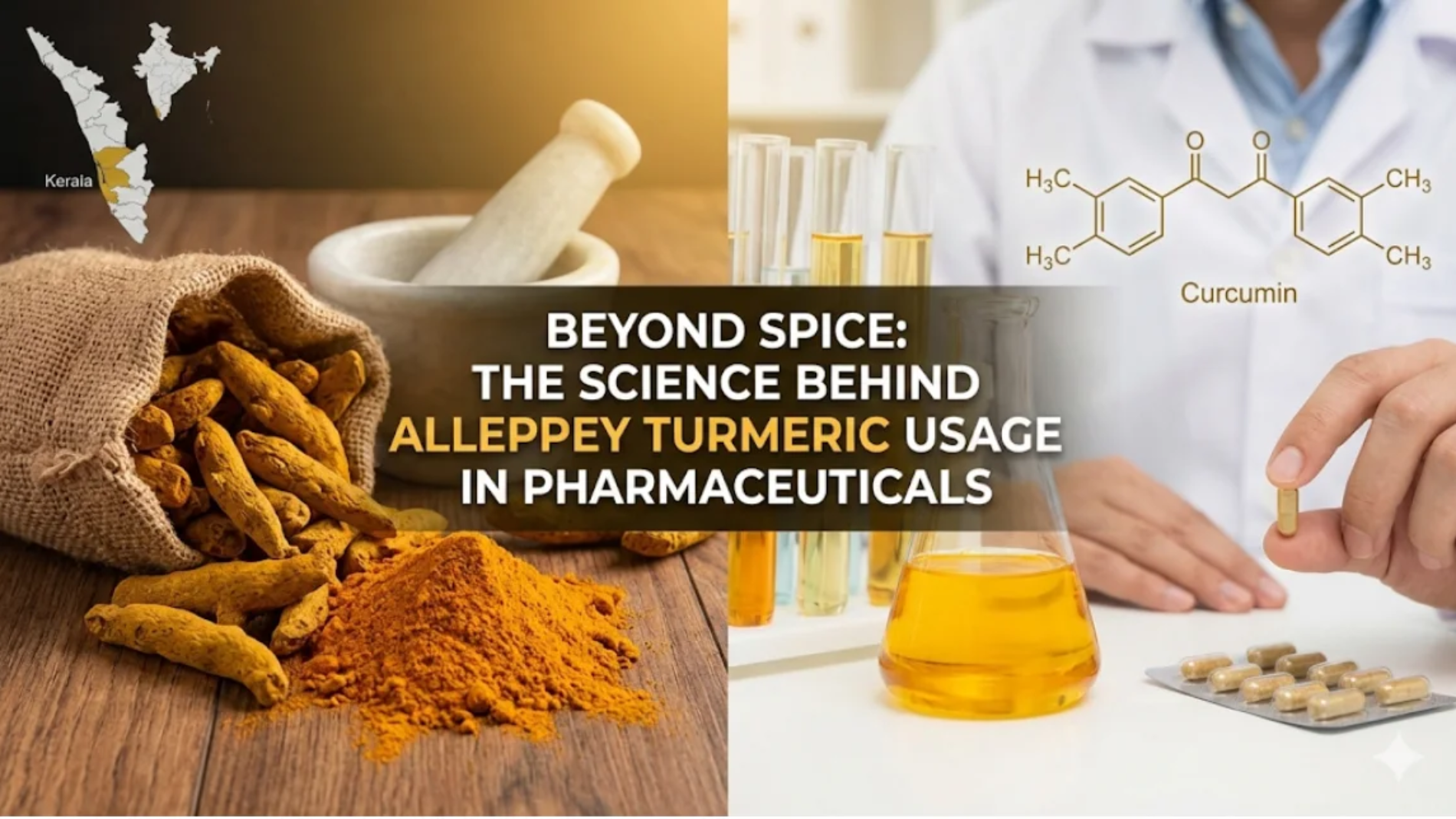
For centuries, turmeric was merely the golden hue in a curry or a household remedy for cuts. Today, it is the superstar of the nutraceutical and pharmaceutical industries. However, not all turmeric is created equal. When pharmaceutical giants and supplement manufacturers source raw materials, they bypass the common culinary grades and head straight for a specific region in Kerala, India.
The reason? Alleppey Turmeric Usage in Pharmaceuticals is driven by hard science, not just tradition. Unlike its lighter, brighter counterparts used in food coloring, Alleppey turmeric is a chemical powerhouse. It boasts naturally high levels of curcumin, the bioactive compound responsible for the plant’s medicinal properties.
For buyers and R&D heads, understanding the technical superiority of Alleppey Finger Turmeric (AFT) is crucial for formulating effective, high-potency drugs and supplements.
1. The Curcumin Advantage: 6.5% vs. 2%
The primary metric driving Alleppey Turmeric usage in pharmaceuticals is the percentage of curcuminoids. Common market varieties, such as Madras or Erode turmeric, typically contain 2% to 3.5% curcumin. While this is sufficient for food flavoring, it is inefficient for medicinal extraction.
Alleppey Turmeric, specifically grades like Alleppey Supreme and IISR Pratibha, consistently delivers a curcumin content ranging from 5% to 7%.
Higher Potency: A single gram of Alleppey powder delivers nearly double the active therapeutic dose compared to standard varieties.
Therapeutic Efficacy: Research links this higher concentration directly to better outcomes in treating chronic inflammation and oxidative stress.
Spice Up Your Business with Authentic Indian Flavors
Import and Export Excellence from India!
2. Extraction Efficiency and Cost-Effectiveness
For pharmaceutical companies, the usage of Alleppey Turmeric is a matter of economics as much as efficacy. When manufacturing curcumin extract (95%) or oleoresins, the yield depends entirely on the quality of the raw material.
Lower Input Ratios: Because Alleppey turmeric has nearly twice the curcumin content of other varieties, manufacturers process less raw material to extract the same amount of active compound.
Solvent Efficiency: Processing higher-density curcumin rhizomes reduces the volume of solvents (like ethanol or ethyl acetate) required per batch, lowering production costs and environmental impact.
3. The Color Chemistry: ASTA Values as a Purity Marker
In pharmaceuticals, visual indicators often correlate with chemical density. Alleppey Turmeric is distinguishable by its deep, dark orange-yellow color, often described as “ochre” rather than bright yellow.
This pigmentation is measured by ASTA color values.
Alleppey Grade: ASTA 160–220.
Standard Grade: ASTA 80–120.
The high ASTA value is a direct visual marker of high curcuminoid density. For soft-gel capsule manufacturers, this natural pigmentation also eliminates the need for artificial coloring agents, supporting “Clean Label” claims.
4. Therapeutic Applications in Modern Medicine
Alleppey Turmeric usage in pharmaceuticals spans several therapeutic categories, driven by its potent anti-inflammatory and antioxidant profile.
Anti-Inflammatory Drugs (NSAID Alternatives): Curcumin from Alleppey turmeric inhibits the COX-2 enzyme, similar to ibuprofen, but without the gastric side effects. It is widely used in formulations for rheumatoid arthritis and osteoarthritis.
Neuroprotective Formulations: High-purity curcumin is being researched for its ability to cross the blood-brain barrier, showing promise in delaying the onset of Alzheimer’s and Parkinson’s disease.
Bioavailability Enhancers: Because Alleppey turmeric is rich in essential oils (3.5% to 5.5%), it naturally aids the absorption of fat-soluble curcumin, making it an ideal base for “whole spectrum” turmeric supplements.
Spice Up Your Business with Authentic Indian Flavors
Import and Export Excellence from India!
5. Quality Standards and Sourcing
Sourcing for pharmaceuticals requires strict adherence to safety standards. Unlike open-market spices, pharmaceutical-grade Alleppey Turmeric is often subject to rigorous testing.
Heavy Metal Testing: Ensuring lead and chromium levels are below stringent pharma limits (USP/EP standards).
Microbiological Purity: Steam sterilization is often employed to ensure the powder is free from Salmonella and E. Coli while preserving the heat-sensitive curcumin.
Traceability: Buyers should look for Geographical Indication (GI) tags or specific cultivar names like IISR Alleppey Supreme to ensure authenticity.
The shift from synthetic to natural medicine has placed Alleppey Turmeric at the center of pharmaceutical innovation. Its superior curcumin content, extraction efficiency, and proven therapeutic benefits make it the gold standard for drug and supplement manufacturers.
For global buyers, understanding the science behind Alleppey Turmeric usage in pharmaceuticals is the first step toward creating products that deliver genuine health results. When potency matters, Alleppey is the only logical choice.
Frequently Asked Questions (FAQs)
1. Why is Alleppey turmeric preferred over Madras turmeric for pharmaceuticals?
Alleppey turmeric has a significantly higher curcumin content (5-7%) compared to Madras turmeric (2-3%). This makes it far more potent for medicinal use and more efficient for extracting curcumin compounds.
2. What is the ASTA color value of pharmaceutical-grade Alleppey turmeric?
Premium Alleppey turmeric typically has an ASTA color value between 160 and 220. This deep orange color indicates a high concentration of curcuminoids.
3. Can Alleppey turmeric be used for arthritis medication?
Yes. Its high curcumin content acts as a powerful anti-inflammatory agent, inhibiting pathways like NF-κB and COX-2, making it a key ingredient in natural arthritis supplements.
4. Is Alleppey turmeric better for curcumin extraction?
Absolutely. Because it contains nearly double the curcumin of other varieties, manufacturers need to process less raw material to get the same yield of 95% Curcumin extract, saving time and money.
5. Does Alleppey turmeric contain essential oils?
Yes. Besides curcumin, Alleppey turmeric contains 3.5% to 5.5% volatile oils. These oils contribute to its aroma and may help improve the absorption (bioavailability) of curcumin in the body.
6. Is Alleppey turmeric the same as Kasturi Manjal?
No. Alleppey turmeric (Curcuma longa) is the edible, high-curcumin variety used for medicine and food. Kasturi Manjal (Curcuma aromatica) is a non-edible, aromatic variety used primarily for skincare.
7. How can I verify if my turmeric is authentic Alleppey grade?
You should request a Certificate of Analysis (COA) from your supplier. Look for a curcumin content above 5% and an ASTA color value above 160. Genuine Alleppey turmeric is darker and more oily than standard powder.
8. What varieties of Alleppey turmeric are best for export?
High-yielding varieties like IISR Pratibha and IISR Alleppey Supreme are top choices. They are developed specifically to have high curcumin levels (up to 5.5-6%) and disease resistance.
About us
We bridge the gap between local producers and global markets, ensuring seamless trade facilitation with exceptional quality and reliability. We provide quick delivery services with customized packaging with all approval of International Certificates (Spices board India, MSME, IEC, fssai, FIEO, APEDA, EU certification, FDA and Many More)
Contact us
Shop No. 3, Ganesh Prestige Sr. No. 2/15, Near Laxmi Jewellers, Dhanakawadi, Pune – 411043, Maharashtra INDIA.
Call On
+91 9545205050
+91 9822422584
Leave A Comment