

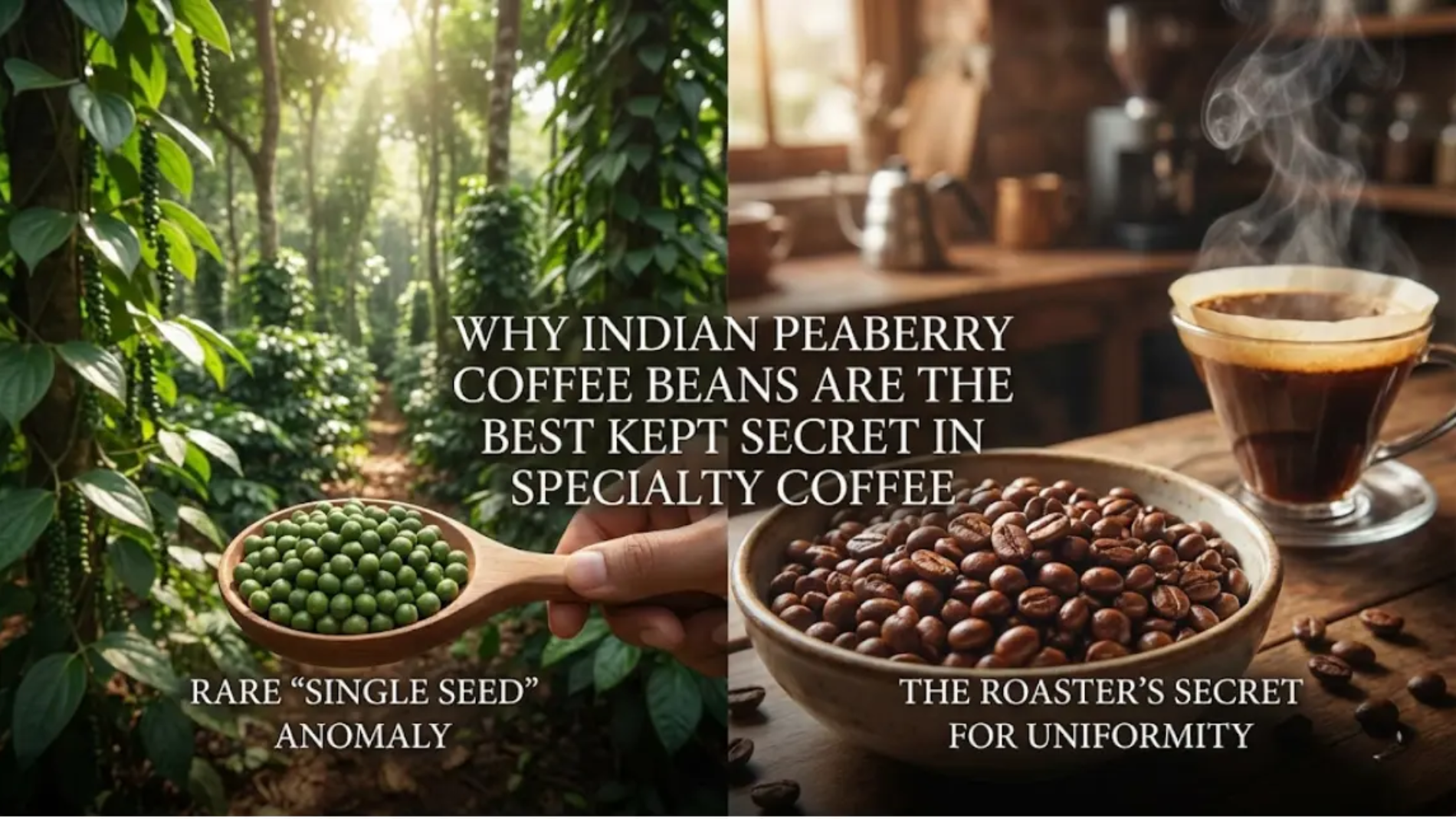
In the vast and competitive world of specialty coffee, roasters and importers are constantly hunting for the next big thing. They look for distinct flavor profiles, unique processing methods, or rare origins. Yet, often overlooked in the bulk sacks of green coffee is a tiny, round botanical anomaly that packs more flavor per gram than almost any other bean: the Peaberry.
Specifically, Indian Peaberry Coffee Beans are emerging as a hidden gem. While the world fights over Geishas and Bourbons, savvy buyers are quietly securing lots of this rare Indian export. Representing only about 5% of any coffee harvest, these beans are not just a genetic quirk; they are a powerhouse of flavor, density, and roasting consistency.
Here is why Peaberry Coffee Beans sourced from the shade-grown estates of India are the industry’s best-kept secret—and why you need them in your inventory.
The "5% Anomaly": What is a Peaberry?
To understand the value, one must understand the botany. Typically, a coffee cherry produces two seeds (beans) that grow flat against each other—this is why regular coffee beans have a flat side.
However, in roughly 5% of cherries, a natural mutation occurs where only one of the two ovules is fertilized. The remaining seed grows alone, with no neighbor to flatten it. It curls in on itself, becoming small, dense, and round like a pea. Hence the name: Peaberry.
For years, these were sorted out and discarded as “defects.” Today, we know better. Because the coffee tree channels all the energy, nutrients, and sugars of that cherry into a single seed instead of sharing it between two, Peaberry Coffee Beans are believed to possess a more concentrated and intense flavor profile.
The Roaster’s Dream: Heat Transfer and Consistency
Ask any master roaster about their biggest challenge, and they will likely mention “evenness.” Flat beans can sometimes roast unevenly, with the thin edges burning faster than the thick center.
Peaberry Coffee Beans solve this physics problem. Their almost perfectly round shape allows them to roll freely in the roasting drum. This results in:
Superior Heat Transfer: The beans absorb heat uniformly from all sides.
Even Development: You rarely find “tipping” or scorched edges on a Peaberry.
Better Crack Control: The snap of the “first crack” is often more distinct and uniform.
For importers selling to artisanal roasters, offering Indian Peaberry is a massive selling point. It is a bean that makes the roaster look good, producing a cup with exceptional clarity and balance.
Spice Up Your Business with Authentic Indian Flavors
Import and Export Excellence from India!
The Indian Advantage: Shade-Grown Complexity
Peaberries exist in every coffee origin, from Brazil to Kenya. So, why choose Indian Peaberry Coffee Beans? The answer lies in the terroir.
India is practically the only country where coffee is grown entirely under a two-tier canopy of shade trees. These estates are biodiversity hotspots, often intercropped with pepper vines, cardamom, clove, and nutmeg.
Slow Maturation: The shade slows down the ripening process, allowing the Peaberry Coffee Beans to develop complex sugars and organic acids.
Spicy Undertones: Indian Peaberries often carry subtle, exotic notes of spices and dark chocolate that you won’t find in Latin American varieties.
Low Acidity: Indian coffee is naturally lower in acidity. A Peaberry form concentrates the body and sweetness without spiking the acidity, creating a smooth, “stomach-friendly” espresso.
Arabica vs. Robusta Peaberry: Choosing Your Profile
When sourcing wholesale Peaberry Coffee Beans from India, you aren’t limited to just one species. Both offer distinct advantages for different market segments.
Arabica Peaberry: These are the crown jewels. Sourced from high-altitude estates (like Baba Budan Giri), they offer a cup that is bright yet creamy, with notes of citrus, caramel, and nuts. They are perfect for single-origin pour-overs.
Robusta Peaberry: A rarity within a rarity. These beans are incredibly dense and potent. They produce thick, golden crema and have a bold, punchy flavor profile. They are the secret weapon for adding body and caffeine to premium espresso blends without introducing bitterness.
The Scarcity Marketing Angle
For private label brands and coffee shops, storytelling is key. Peaberry Coffee Beans offer a built-in narrative of exclusivity.
“Limited Edition”: Since they make up only 5% of the crop, they are naturally limited in supply.
“Hand-Sorted Quality”: separating Peaberries requires distinct sieve grading (screens 13-15 usually) and often extra optical sorting to ensure purity.
Marketing a “Reserve Lot Indian Peaberry” creates a sense of urgency and prestige for consumers who are tired of the standard supermarket blends.
Spice Up Your Business with Authentic Indian Flavors
Import and Export Excellence from India!
A Tiny Bean with Huge Potential
The days of viewing the Peaberry as a mutant defect are long gone. Today, it represents the pinnacle of selection and concentration. Indian Peaberry Coffee Beans offer a unique combination of roasting technicality and sensory delight—easy to roast, complex to taste, and steeped in the rich heritage of Indian shade farming.
For importers and buyers, securing a few bags of this “Pearl of Coffee” is a strategic move. It differentiates your offering and gives your customers a taste of something truly special.
Frequently Asked Questions (FAQs)
1. Do Peaberry beans taste different from regular coffee beans?
Yes. Because all the nutrients of the coffee cherry are concentrated into a single seed, Peaberry Coffee Beans often have a sweeter, brighter, and more intense flavor profile compared to flat beans from the same tree.
2. Are Peaberry beans harder to roast?
Actually, they are often easier to roast evenly. Their round shape allows them to roll smoothly in the drum, preventing hot spots. However, because they are denser, they may require a higher charge temperature or more heat energy to penetrate the core.
3. Why are Peaberry Coffee Beans more expensive?
It comes down to scarcity and labor. They represent only about 5% of the total harvest. Additionally, separating them requires specific screening and sorting machinery, adding to the processing cost.
4. Is Indian Peaberry Arabica or Robusta?
It can be either! You can buy Arabica Peaberry (mild, aromatic, acidic) or Robusta Peaberry (strong, bold, high caffeine). Both occur naturally in Indian coffee plantations.
5. Does Peaberry coffee have more caffeine?
There is a common belief that Peaberries have higher caffeine density, especially in Robusta Peaberries. While the difference per bean is minimal, the higher density of the bean means you might get slightly more caffeine by weight compared to a less dense flat bean.
6. What represents the best roast level for Indian Peaberry?
For Indian Arabica Peaberry, a Medium Roast (City+) is ideal to highlight the chocolate and spice notes. For Robusta Peaberry, a Medium-Dark (Full City) roast works best to maximize body and crema while muting acidity.
7. Can I use Peaberry beans in an espresso machine?
Absolutely. In fact, they are excellent for espresso. Indian Peaberries, particularly the Robusta variety, produce fantastic crema and a heavy, syrupy body that stands up well to milk.
8. How should I store bulk Peaberry beans?
Like all premium green coffee, Peaberry Coffee Beans should be stored in a cool, dry place, ideally in GrainPro or Ecotact bags to maintain moisture content. Because they are dense, they have a good shelf life, but freshness is still paramount.
About us
We bridge the gap between local producers and global markets, ensuring seamless trade facilitation with exceptional quality and reliability. We provide quick delivery services with customized packaging with all approval of International Certificates (Spices board India, MSME, IEC, fssai, FIEO, APEDA, EU certification, FDA and Many More)
Contact us
Shop No. 3, Ganesh Prestige Sr. No. 2/15, Near Laxmi Jewellers, Dhanakawadi, Pune – 411043, Maharashtra INDIA.
Call On
+91 9545205050
+91 9822422584
Leave A Comment